

Universities spend a great deal of time preparing their students for the serious things: assessments, presentations, interviews and careers, in an increasingly complex world of employment.
Playfulness, as a practical learning mechanism, rarely makes this list. In fact, it’s something often dismissed as childish and distracting, or something that students are expected to outgrow once they enter higher education.
However, after years of teaching performance studies, cultural production and music as well as managing work-based learning programmes at my university’s Employability and Entrepreneurship Office, I’ve become convinced the very opposite is true.
- Don’t cry for me, academia: gamifying the early career experience
- Go beyond play and engage students with game-based learning
- Spotlight guide: How to motivate students and staff in higher education
Playfulness is not the enemy of excellence. In fact, it creates the conditions for excellence by cultivating curiosity, experimentation and human connection – precisely the capacities that distinguish us in the age of artificial intelligence.
As AI becomes increasingly capable of doing more of our thinking and analysis, the qualities distinguishing human beings are ever more valuable. Listening, empathy, collaboration, adaptability and presence are no longer just nice-to-have additions to a graduate’s skill set – they’re essential.
Learning to listen differently
My teaching is rooted in the Playground Approach, created and developed by composer, conductor, educator and researcher Keren Rosenbaum. Rather than being a fixed teaching method, the Playground Approach is a relational, practice-based approach that develops listening, creativity and human connection through multisensory communication and shared creative experiences.
In the Playground Approach, play isn’t treated as entertainment or a break from serious learning. Rather, it is a structured space where students develop attunement, reflexive listening and shared authorship, learning to express themselves and respond thoughtfully to the people around them.
As a musician, I’ve always been fascinated by listening, an action most people think is just about hearing words. But musicians understand there’s far more at play. We pay close attention to rhythm, pauses, intonation, tension and emotion. We notice what’s happening between the notes as much as the notes themselves.
This perspective changes the way that students communicate. Instead of asking them to speak or present, I might encourage them to express the concept of stress through movement, sound, visual image, rhythm, gesture or spatial arrangement.
For many business or engineering students, this exercise initially feels uncomfortable or even slightly ridiculous. That discomfort is exactly where learning begins.
A space where mistakes are welcomed
Before students can start to collaborate creatively, they need to feel safe enough to experiment.
Three simple commitments shape our classes: embrace confusion, avoid judgement and welcome mistakes. These sound like straightforward ideals, until someone stands in the middle of the room and is asked to communicate without using words.
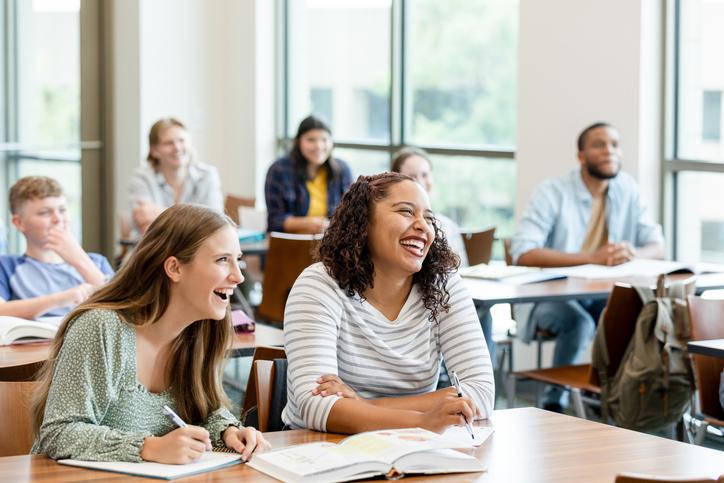
The first reaction is often laughter or self-consciousness. Gradually, however, students start to trust each other, listen more carefully and become comfortable with uncertainty. This process itself becomes a key part of the lesson.
When we create final performances, I never arrive with a finished script or predetermined outcome. Instead, students consider questions that matter to them and then build something together.
Recent projects have explored AI and academic integrity, imagined futures in which machines dominate society and reflected on what matters most in our use of time and space. The destination is unknown at the beginning of the semester, but our collaborative journey produces some of the deepest learning.
Why playfulness matters
Many people confuse playfulness with gamification, but they’re fundamentally different approaches.
Gamification usually revolves around competition, while playfulness is a mindset. It’s the ability to remain curious, adaptable and open while working seriously with others.
Musicians illustrate this perfectly. We talk about playing an instrument, yet there’s nothing casual about mastering a Chopin étude or performing with an orchestra. Playfulness and discipline exist side by side.
The same is true in higher education. Students who are able to rediscover a playful mindset leave the classroom with something far more valuable than a good grade. They develop confidence, are more willing to contribute unusual ideas and learn how to adapt when the unexpected happens. These are precisely the qualities employers increasingly tell us they need.
The Playground Approach helps make this process visible and practical. Students begin to recognise that communication is shaped not only by what we say, but also through tone, rhythm, gesture, silence, movement and the way a group gradually responds as a living system. Those experiences develop a deeper awareness of how collaboration really works.
The hidden value of the arts
Working within a liberal arts environment enables these ideas to flourish.
Business students, engineers and social scientists quickly realise that every presentation, interview or team meeting they participate in is also a performance. Success depends on technical knowledge but also involves body language, tone of voice, audience awareness and an ability to build genuine human connections.
All too often, the arts are still viewed as mere entertainment or decoration rather than as a practical way of developing these capabilities.
Yet the creative and cultural industries demonstrate their growing value. Success increasingly depends on collaboration, adaptability and creative confidence, all qualities that are fostered through arts-based learning and increasingly sought in every kind of workplace.
Perhaps the greatest contribution of arts-based education, then, is not artistic excellence alone, but preparing students to understand themselves, connect with others and contribute meaningfully in an increasingly interconnected and complex world.
Three ways to bring playfulness into teaching
Educators don’t need to become musicians or actors to adopt a more playful approach.
First, encourage students to change perspective. Ask a business student to approach a problem like an artist, or an engineer to think like a performer. Fresh perspectives often produce fresh solutions.
Second, create spaces where uncertainty is accepted. Innovation rarely happens when students are afraid of making mistakes.
Finally, remember that listening is a skill that deserves as much attention as speaking. Encourage students to notice tone, movement, silence, emotion, rhythm, gesture and the wider atmosphere of the room, as well as the words being used.
A distinctly human advantage
One of the questions I return to most often is simple: what can human beings still offer that AI can’t? For me, the answer begins with attunement.
It is our ability to notice another person’s hesitation, sense the mood of a room, build trust, improvise together and create something meaningful that no algorithm could have planned or predicted.
Playfulness isn’t a distraction from serious learning. It’s one of the most powerful ways we have of preparing students for a future in which the most valuable skills may be the most deeply human ones: listening, presence, responsiveness, imagination and a capacity to create meaning together.
Isabel Taurel is lecturer in the arts and manager of work-based learning programmes at Al Akhawayn University.
If you would like advice and insight from academics and university staff delivered direct to your inbox each week, sign up for the THE Campus newsletter.
comment