



Doctoral supervision is one of the most important and complex roles in academia. Supervisors support and influence not only the development of a research project that “extends the forefront of the discipline” but also the confidence, well-being and career prospects of the doctoral student carrying out the project.
Yet, many academics have had limited opportunity to take part in structured training or development to support this responsibility, either as new supervisors or to grow in the role.
We recognised the need to do more in this area. While supervisor training had existed previously at the University of Southampton, it was not consistently available. Over the past two years, we have designed a new professional development programme for supervisors that is both consistent and flexible, reflecting sector expectations such as those laid out in the UKRI “Statement of expectations for doctoral training” and best practice from research literature and organisations such as the UK Council for Graduate Education (UKCGE).
Here’s what we did and what we learned along the way.
How we developed our supervision development programme
Understanding the needs
Our first step was simple: understand what supervisors and students need. Using surveys, focus groups and semi-structured interviews, we explored where supervisors felt most and least confident, and what challenges they faced day to day.
We also drew on wider evidence, internal doctoral surveys, and national datasets such as the UKCGE UK Research Supervisor Survey and the Postgraduate Research Experience Survey to see how local experiences aligned with country-wide trends.
- Why universities should be turned upside down
- Why professional development in graduate supervision matters
- How can PhD researchers be supported to complete an alternative format thesis?
To guide our thinking, we developed a theory of change for the programme, a visual road map linking what we wanted to achieve (better supported, more confident supervisors) to the activities, conditions and evidence needed to get there. This framework kept us focused on purpose rather than outputs and ensured evaluation was built in, not bolted on. It helped us articulate why the programme mattered and how each element contributed to the bigger picture of supervisory practice and culture.
This mapping helped us identify which gaps could be addressed through training and which pointed to deeper organisational issues, such as workload or recognition. The exercise gave us a clear, evidence-based starting point and, crucially, legitimacy when presenting proposals to institutional stakeholders.
Build relationships before resources
Programme design is relational work. We spent time communicating and listening to faculty directors, administrators, professional services teams and central Doctoral College colleagues. Each conversation revealed distinct local challenges, from inconsistent communication to differing interpretations of policy.
Trust took time to build, but those relationships have been vital. They helped us co-create and tailor the programme to real needs rather than assumptions, and they created advocates who now champion the work within their faculties. Investing early in these connections also made it easier to secure institutional buy-in and practical support later.
Balance consistency and flexibility
Supervisors wanted clarity about what support was available, when sessions would run and how everything fitted together. We developed a consistent annual programme mapped to key points in the doctoral calendar (for example, progression reviews and examinations), so supervisors can plan ahead for their own professional development. However, doctoral education is rarely uniform. Disciplines vary widely in their supervisory norms, and priorities can shift quickly with sector changes. Our programme needed to flex with that reality.
We now run a core series of sessions open to all, alongside faculty-based supervisor forums that address local topics. This combination has created both a shared baseline and the freedom for faculties to explore issues in their own context. It also reinforces a sense of community among supervisors who might otherwise work in isolation.
What the programme looks like in practice
Bringing these principles together, and informed by longitudinal evaluation and stakeholder insight, we designed a progressive, blended professional development programme that provides clarity while remaining flexible enough to meet supervisors where they are, without prescribing a single pathway.
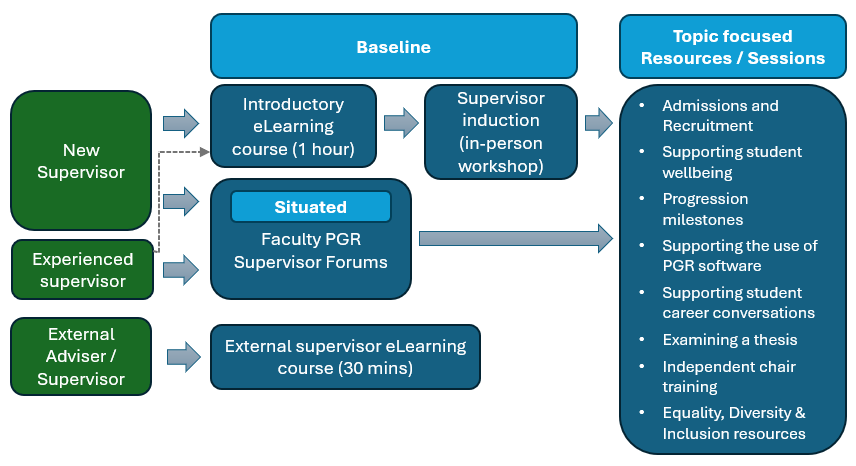
At its core, the programme combines:
- short introductory online modules that supervisors can complete flexibly. These establish a shared baseline and reduce the need to cover foundational content in live sessions
- live interactive sessions, which focus on application, peer discussion and case-based learning. This allows supervisors to explore real scenarios rather than passively receive information
- faculty-based supervisor forums, which provide local spaces to discuss discipline-specific challenges, translate institutional guidance into practice and share practice across schools, disciplines and staff experiences
- topic-focused sessions that align with the doctoral calendar. These are often recorded to build a growing resource library.
Rather than mandating participation, we focus on clarity and coherence, helping supervisors understand what support is available, when it might be useful, and how different elements connect. This balance of consistency and choice has supported engagement while respecting academic autonomy.
Keep adapting
Doctoral supervision, like research itself, doesn’t stand still. Sector guidance changes, new challenges emerge and student expectations evolve. Our final lesson has been the need for continual adaptation. Returning to our theory of change has been invaluable for this. It serves as both a development map and an evaluation tool, helping us track what’s working, revisit assumptions and show impact in meaningful ways. Using it has kept the programme agile, reminding us that the goal isn’t about more development sessions but supporting positive research culture within the PGR-supervisory relationship.
Through longitudinal evaluation, we review participation data and feedback, updating the content and structure accordingly. For instance, recent sessions have focused more on intersectoral supervision and well-being support, reflecting current priorities. Flexibility has become a core design principle rather than an afterthought.
Three lessons to share
For institutions looking to strengthen supervisor development, three lessons stand out from our experience:
- Start with insight, not assumption. Gather evidence from supervisors and students first to build credibility, inform evaluation and ensure relevance.
- Relationships are the infrastructure and communication is key. Genuine collaboration across faculties and services is slower but far more sustainable than top-down design, and it provides the trust needed for honest reflection and continuous improvement.
- Plan for evolution and evaluation. A good programme is never finished; build in moments to pause, review and learn from what’s working. Embedding evaluation from the start keeps the programme responsive and grounded in real experience.
Paul Clarkson is a senior teaching fellow in academic practice (academic developer – research), and Tahrima Hossain is a teaching fellow in academic practice (evaluation), both in the Centre for Higher Education Practice at the University of Southampton.
If you would like advice and insight from academics and university staff delivered direct to your inbox each week, sign up for the Campus newsletter.



comment