

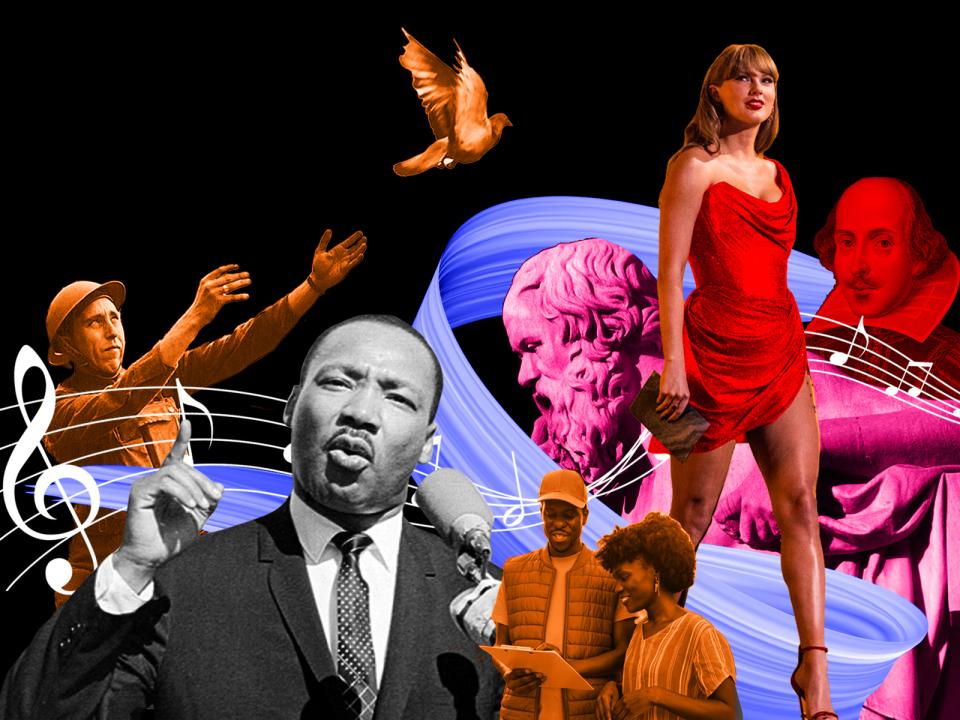
The arts and humanities have long been a lightning rod for attacks on higher education. Perennial questions about graduate outcomes, career prospects and value for money now mix with accusations of “woke” thinking.
Yet, amid the threat of AI-driven automation in the workforce, fierce competition for entry-level jobs, and complex global problems such as climate change, the skills that humanities disciplines are built upon are vital. These skills – such as critical thinking, communication and creativity – are also key to universities’ capacity to share knowledge with industry, policymakers and the public. When it comes to understanding how high-tech solutions can best be applied in the real world, often the barriers are not technical but human, as low vaccine take-ups show.
These human skills are not unique to disciplines such as history, philosophy, literature, linguistics, performance and visual arts, of course. The need for deep thinking and analysis across all areas of academic enquiry is embedded in interdisciplinarity and STEAM initiatives, which integrate science, technology, mathematics and engineering with arts and humanities.
At their core, the arts and humanities interrogate what makes us human and how we understand and communicate with the world. In this collection, contributors from around the globe articulate the value that these disciplines bring to students, industry, government and society, when taught and designed effectively. It also considers how arts-based research can drive discovery, the role of interdisciplinarity in teaching and research, and how humanities-led expertise supports sustainability and inclusion.
How arts and humanities can build career-readiness and future skills
Sought-after skills such as critical and creative thinking, adaptability and empathy are deeply embedded in arts and humanities disciplines – from history to game design. The challenge for universities, then, is to make more evident to students, employers and policymakers how these degrees prepare graduates for the workforce. Read about how experts are surfacing the real-world value of a liberal arts education and explicitly linking disciplinary and professional skills.
The case for degrees that teach us how to think: The humanities are often the first target in any debate about the value of higher education. Yet, as Michelle Moseley-Christian of Virginia Tech argues, these disciplines cultivate critical skills, resilience and, yes, viable career paths.
For an agile future workforce, embed a liberal arts education system: A liberal arts education can foster the adaptability and critical-thinking skills that employers look for. Here, Abderrahim Agnaou of Al Akhawayn University explains how to adapt the model to your region.
Philosophy graduates need to know they are highly employable: Many prospective philosophy students will understandably be concerned about their job prospects, so they need courses that translate its skills for the workplace, writes Jonathan Webber of Cardiff University.
Tips for debunking the arts and humanities myth: David Dodick from the University of California, Berkeley offers practical pointers, based on a course he designed and taught, aimed at communicating the value of arts and humanities degrees for various careers.
Showing employers the value in humanities and social sciences: Jonathan Sim from the National University of Singapore describes how he engaged with local employers to open internship opportunities to humanities and social sciences students.
Arts and humanities scholars can engage with policy, too: Charlotte Faucher from the University of Bristol shares advice for academics who want to develop their impact profile while staying true to their roots.
Six thinkers and five tips to reimagine business education: Take inspiration from sociology, philosophy and educational theory for a well-rounded, resilient approach to business education, write academics from Al Akhawayn University.
Where arts and humanities enrich interdisciplinary teaching and research
Interdisciplinarity comes into its own when it draws on a broad array of perspectives and specialisms. Breaking arts and humanities out of their silos exposes students in other disciplines to social, emotional and cultural considerations they may hitherto have overlooked. For example, engineering students may engage more deeply with the psycho-social impact of their products and designs. While artists, historians and philosophers can benefit from the tech and data skills more commonly associated with STEM. The benefits run both ways, as these articles explain.
STEAM-based education is the way forward: Hanifa Shah of Birmingham City University outlines how to integrate science, technology, engineering, arts, humanities and mathematics to build skills and address real-world problems.
Putting arts and humanities at the heart of research: Disciplines too often are siloed. So, ask Lisa McNair and Tom Martin of Virginia Tech, how do universities encourage science and technology fields to work with arts and humanities?
How to humanise engineering education and why we must: Engineering sciences are still not gender equitable, writes Rich McIlroy from the University of Southampton. Incorporating more social sciences into engineering education could help address the imbalance.
Weave interdisciplinarity into the identity of your humanities department: Flexibility within department structures can allow interdisciplinary work and collaboration to flourish, without undermining staff specialisation. Here, Hang Xing from the Hong Kong Polytechnic University explains how.
Campus talks: social artist Helen Storey on working on the boundary of fashion and science: In this podcast episode, the UNHCR’s first designer-in-residence talks about donating her creative archive to the University of the Arts London, and how the arts can connect people with issues such as climate change and the refugee crisis.
Keeping humanity at the heart of tech advancement
“While technical proficiency is undoubtedly crucial, the ability to navigate the nuances of human interaction, empathy and ethical decision-making is equally vital,” writes Lucy Gill-Simmen of Royal Holloway, University of London. As digital technologies, now led by AI, transform our societies, it is imperative that the human, social and cultural implications of new tools are scrutinised. And as machines automate more tasks, human skills become more highly prized. These articles put the case for cultivating skills borne out of arts and humanities alongside data, computing and AI literacies.
Harnessing the humanities for transformative tech leadership: Rishi Jaitly from Virginia Tech explains why data and technology leaders also need an education in the liberal arts.
In the age of AI, teach your students how to be human: Look to the arts to help develop your students’ skills for navigating the real world. Lucy Gill-Simmen proposes her vision of a more well-rounded education.
How combining VR with cultural identity can make interdisciplinary learning more impactful: Antonio Juárez and Rubén Vázquez from Tecnológico de Monterrey share a project to design human settlements on the moon that pairs learners across architecture, design and arts with VR tools.
Creativity as the key to problem-solving
Complex challenges – whether that’s climate change or how to manage AI – require new mindsets or ways to tap into existing thinking to make fresh connections. The creative process, and writing ideas down coherently, requires space for reflection and experimentation. It teaches students powerful problem-solving skills and resilience to keep going even when inspiration is absent.
Poetry for solving problems: Grappling with a problem? Try writing a poem about it to aid your subconscious in finding a solution. Sam Illingworth of Edinburgh Napier University explains how.
Why slowness is a superpower in creative education: Good ideas often appear in quiet moments. David Thompson from the University of Lincoln argues for protecting incubation time.
Poetry is a door into many disciplines, not just a literary one: A poem can act as a memory aid, ground facts in individual experience and prompt questions about policy, power and generational impact, says Pádraig Ó Tuama of Poetry Unbound.
‘What artists do is say the quiet bits out loud’: Students will face the harsh demands of problem-solving in their professional lives, says Stephen Sewell from Australian National University, and we need to help them tap into the creativity that leads to novel solutions.
‘The arts and humanities celebrate what makes us human’: As deepfakes blur truth and political divides widen, the arts and humanities offer essential skills such as reflection and resilience. Patty Raun of Virginia Tech explains.
Why arts and humanities are vital to improving sustainability
When rising carbon emissions, collapsing ecosystems and inequality seem too vast to grasp or to communicate to policymakers, the arts and social sciences provide a conduit to make the overwhelming tangible. Poetry can give a language to climate anxiety. Theatre can help audiences see social justice at a human scale. The work of spurring action from knowledge and theory requires the storytelling, interpretation and analytical skills in which the arts and humanities specialise – plus a dose of imagination to envision a better tomorrow.
Looking for our environmental future in the poetic past: How can studying a poem or writing a story give students the skills to imagine a healthy planetary future? Stephanie Jones of the University of Southampton explains the link between literature and environmental literacy.
Social sciences, humanities and arts are critical for sustainability: The neglect of social sciences, humanities and arts is at the heart of why the shift to sustainability has been slow − and why it may eventually fail, say Eric Neumayer and Charles Joly from the London School of Economics and Political Science.
How can we decarbonise knowledge production? The path to net zero requires an interdisciplinary approach that includes expertise from the humanities and social sciences as well as STEM, argues Priya Vijaykumar Poojary of the Manipal Institute of Social Sciences, Humanities and Arts.
Using creative research methods to solve the plastics crisis: Incorporating theatre, music and the visual arts as research tools complements analytical and qualitative approaches to environmental challenges, writes Cressida Bowyer of the University of Portsmouth.
How storytelling boosts environmental impact and engagement: Presenting sustainability research in a story, writes Denise Baden from the University of Southampton, can bridge the gap between complex theory and real-world results for wider audiences and policymakers alike.
The value of arts-based research
Arts-based methods integrate performance, visual art, poetry, oral history and digital media into scholarly enquiry and teaching, and in doing so capture insights that quantitative methodologies cannot. These articles explain how the approach can be applied to questions as diverse as fashion history and cancer research.
Reframing the value of arts-based research: When traditional methodologies struggle to capture sensory, emotional and lived dimensions of culture, researchers can turn to arts-based enquiry. Here, Peng Liu of Macau University of Science and Technology explains how to integrate audio, visual and reflective data collection into research design.
Arts-based methods to foster interactive learning: Human values and relationships can be key contributors in learning. Anne Pässilä from Lappeenranta–Lahti University of Technology LUT and Allan Owens from the University of Chester offer advice on how an arts-based approach can be used.
How to demonstrate the worth of arts-and-humanities-based research: When medical research meets vocal performance, it showcases the work’s tangible benefits and the creative practices that underpin it. Mette Hjort from the Education University of Hong Kong explains.
Thank you to all Campus contributors who shared their expertise and insights in this guide.
If you would like advice and insight from academics and university staff delivered direct to your inbox each week, sign up for the Campus newsletter.
comment