

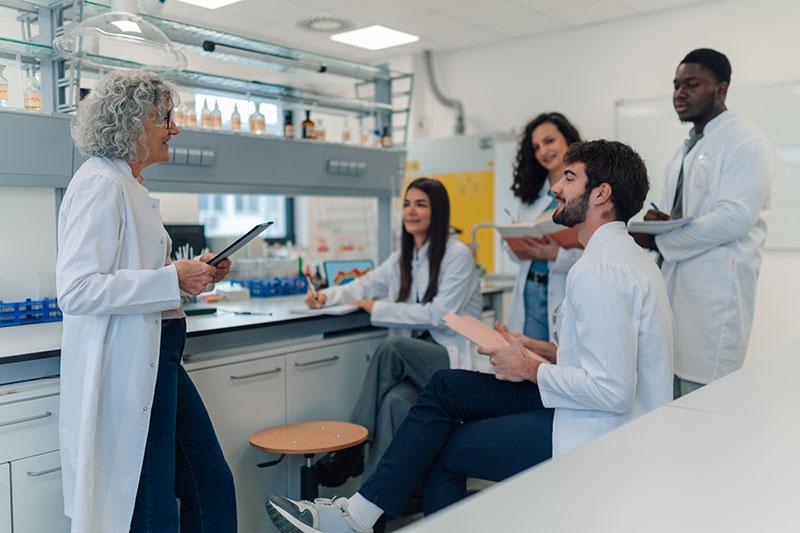
Postgraduate education has traditionally been built around apprenticeship. Students join a lab, learn established methods and gradually absorb the habits of their discipline under the direction of an expert adviser. There is value in that model. But modern research increasingly demands something more collaborative, flexible and intellectually open-ended than the traditional hierarchy allows.
In my experience, students do their best work when they are treated not as assistants advancing someone else’s vision, but as collaborators with ideas, perspectives and expertise of their own. That shift matters not only for students’ professional development but also for the quality of science itself.
In some parts of academia there remains an “old school” mentality that postgraduate students should independently master every aspect of a project. The assumption is that struggling through each challenge alone produces stronger scientists – and sometimes, it is the students themselves who hold and further that mentality.
I increasingly believe the opposite is true.
- Co-creation and empowerment: pathways to better student engagement
- Tips to integrate sustainability into day-to-day university lab practice
- Find a balance with student-centredness
Research today is deeply collaborative. The scientists who thrive are rarely the ones who try to do everything themselves; they are the ones who know how to build networks, seek expertise and work productively with others. Learning to collaborate effectively is therefore not separate from scientific training. It is scientific training.
Room for enquiry
One of the most important parts of mentoring students is helping them discover intellectual ownership over their work. That means giving them room to ask questions, explore new directions and occasionally pursue approaches that I might not initially choose myself. It is not always easy to keep ourselves from interfering – but it is vital to hold back.
As advisers, we all carry assumptions about what methods are most productive or what research directions seem most promising. But science changes quickly. Technologies evolve, analytical tools improve and younger researchers often approach problems differently from how their mentors would have even a few years earlier. If faculty tightly control every project, research risks becoming trapped in older ways of thinking.
Students frequently bring perspectives that improve a project precisely because they have different experiences, different technical fluencies and different intellectual instincts. Creating space for those contributions is not simply generosity; it is a strategic advantage for a research group.
Depth of perspective
There is growing recognition across many fields that diverse teams consistently outperform groups whose members all think similarly. In biology, we sometimes describe related phenomena in terms of the benefits that emerge from diversity within a population – or heterosis. It refers to the phenomenon in which greater genetic diversity in a population leads to improved strength, resilience, adaptability or performance. The same principle applies socially and intellectually. Teams become stronger when people approach problems from different angles.
That diversity is difficult to harness if students are trained only to replicate their adviser’s thinking. Treating students as collaborators instead allows a lab to entertain a wider range of ideas, questions and problem-solving approaches.
The challenges of treating students as collaborators
Of course, this approach also introduces challenges. One of the hardest parts of mentoring is resisting the urge to over-direct students when they encounter obstacles or pursue unfamiliar directions. Advisers naturally want to protect students from mistakes or inefficiencies. But if we intervene too quickly or too often, we deprive students of the opportunity to develop confidence, independence and resilience. The goal is not to eliminate struggle entirely. The goal is to create an environment in which students feel supported enough to take intellectual risks.
Another challenge is scope. Passionate students often want to pursue every exciting idea simultaneously. Part of mentorship involves helping them maintain realistic timelines and manageable project boundaries without extinguishing their enthusiasm.
That balancing act is essential because collaboration is ultimately tied to confidence and identity formation. Take the idea of impostor syndrome – many postgraduates quietly question whether they truly belong in academia or research. Giving them meaningful ownership over projects can help counteract that uncertainty. When students see themselves making decisions, contributing original ideas and helping to shape research outcomes, they begin to recognise themselves as scientists rather than simply trainees.
That transformation is one of the most important outcomes that a postgraduate education can produce.
The collaborative skills that students develop in research groups will shape the rest of their careers. Communication, perspective-taking and intellectual openness matter as much as technical expertise. Successful collaborators learn to meet people where they are, recognise different forms of knowledge and engage respectfully with ideas that differ from their own assumptions.
In research, everyone operates within a particular context that shapes what seems rational or important to them. Productive collaboration depends on understanding those contexts rather than dismissing them. And there is no better place to learn those habits than within postgraduate education itself.
If collaboration will define the future of research – and I believe it will – universities should stop treating collaborative capacity as an incidental by-product of training. We should recognise it as one of the central skills that students need to develop – and we should structure our research cultures accordingly.
Robert Cooper is an invasive species geneticist, assistant professor in the department of fish and wildlife conservation in the College of Natural Resources and Environment and faculty affiliate in the Global Change Center and Invasive Species Collaborative at Virginia Tech.
If you would like advice and insight from academics and university staff delivered direct to your inbox each week, sign up for the Campus newsletter.
comment