

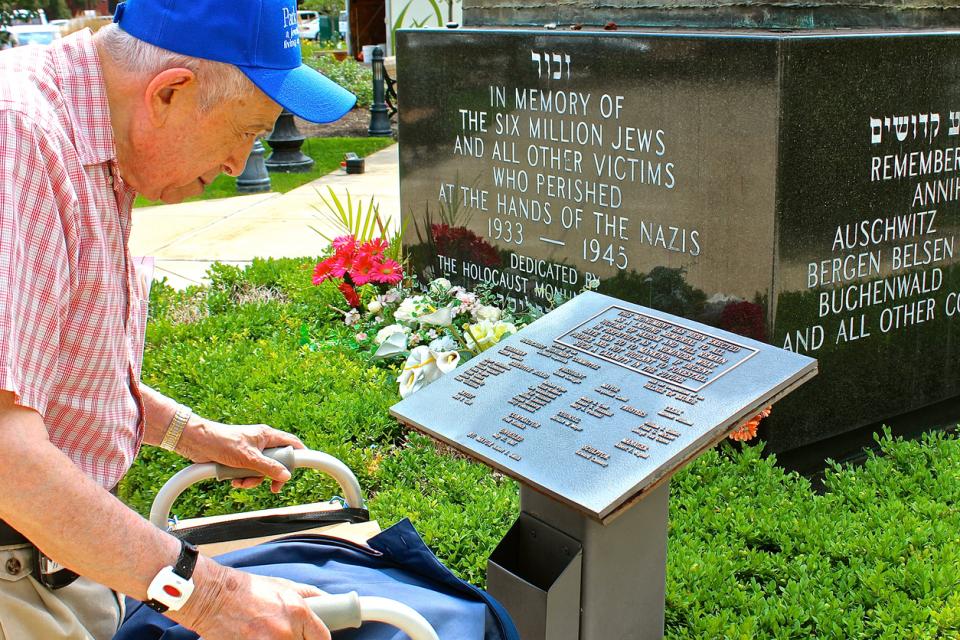
A student was watching a video testimony. A survivor described a reunion with her brother inside Auschwitz. The artificial intelligence read the transcript and flagged the moment as emotionally significant – a reunion that must have provided comfort.
The student knew better because she had watched the video. She knew what the reunion meant: the survivor had seen her brother being led to the gas chambers. AI got the fact right, but it got the meaning catastrophically wrong. That moment didn’t happen by accident: I designed the course to make it unavoidable.
In my seminar, students work weekly with Holocaust survivor testimonies – recorded video interviews from archives like the Fortunoff Video Archive and USC Shoah Foundation. Each week, they upload transcripts into AI tools using shared prompts we develop together. For example, one prompt asks: “If AI interprets this testimony through the concept of trauma, what aspects of the survivor’s experience become harder to see?” Then they write a short reflection comparing what AI found with what they saw watching the video, focusing on moments where the two diverged.
The course is built on a simple asymmetry: AI reads transcripts. Students watch testimony. Those are not the same thing, and the gap between them is where the teaching happens.
Testimony lives in pauses, in a hand gesture held a beat too long, in the shift between a survivor’s voice when they describe what they did and when they describe what they saw. Transcripts capture words; they also strip away almost everything that gives the words their meaning. AI, working only from text, does not know what it’s missing. It keeps going anyway – confidently, fluently, wrong. It doesn’t sit with absence, it fills the gap rather than acknowledging it. The course is designed so students discover this themselves, in material they know better than the machine does. The same structure could apply to any material where meaning exceeds text – interviews, performances or classroom discussions.
- Spotlight guide: Boosting AI literacy across your institution
- How to support students to learn from, with, about and beyond AI
- ‘If you like, I can….?’ Why GenAI needs to come with a health warning
Three design choices can make that discovery unavoidable.
The first is sequencing. Students come in trusting AI too much – they treat it as authoritative before they’ve tested it. That instinct is actually useful, if you sequence carefully. I let students see what AI does well before they confront its limits. Early in the semester, a student found that AI had identified her survivor’s repeated use of the phrase “no question about it” at moments of intense recall – a verbal tic that a human listener might feel without being able to name. The machine named it. Students started describing what one called a “tandem model”: AI organises, humans interpret. That early success matters. If students encounter failure too soon, they dismiss the tool as useless. When failure arrives after they’ve trusted it, it lands with real force.
The second move is mandatory comparison. Students watch the video before they run any prompts. This is non-negotiable. Without it, the task collapses into evaluating AI output against more AI output. The contrast only becomes visible when students bring something to it that the machine doesn’t have – the embodied experience of having watched someone remember.
The third move is reflection that requires articulation. Students don’t merely note where AI was wrong: they have to say how they know. What did they see? Why does it matter? One student wrote that AI had characterised her survivor’s tone as flat and detached. She disagreed. “I watched the video,” she wrote, “and these changes were supplemented with hand gestures and facial expressions which the AI was not able to take into account.” That sentence took real intellectual work. She wasn’t repeating a course principle – she was claiming authority over her own interpretation because she had earned it.
The worry about AI in the classroom is passivity – that students will accept what the tool produces without questioning it. My experience is the opposite. AI’s confident wrongness is one of the most activating teaching experiences I’ve encountered, precisely because students can’t be passive when they know something the machine doesn’t. What they know, in this course, is what they watched – a survivor’s posture when describing arrival at the camp, the silence before a name is spoken. None of that is in the transcript; all of it is in the testimony.
By mid-semester, the questions students brought me had changed entirely. Early on: can I use AI for this? Later: what is it missing? When does my reading outrank the machine’s? That shift – from asking permission to making diagnoses – is what the course is designed to produce.
The student who caught the reunion moment didn’t just flag an error. She wrote about what the error revealed: that there is a category difference between reading about an event and watching someone remember it. AI, she concluded, could do the first but not the second. The course had been trying to build exactly that distinction. She worked it out herself. The machine, failing in front of her on material she knew better than it did, was what made it visible.
The goal is simple: create moments where students know something the machine does not – and must explain why. That is where critical thinking begins.
Jan Burzlaff is a postdoctoral associate in the Jewish Studies programme at Cornell University.
If you would like advice and insight from academics and university staff delivered direct to your inbox each week, sign up for the Campus newsletter.


comment