


Classroom silence and student disengagement remain persistent challenges in teaching. Despite careful course planning, many teachers still find themselves facing quiet classrooms. This silence does not necessarily reflect a lack of ability or interest but typically stems from students’ lack of confidence or fear of making mistakes.
To address drifting attention or lack of participation, teachers are required to move beyond their traditional role of knowledge transmitters and cultivate a truly supportive learning environment. As growth partners for their students, effective teachers do more than deliver clear explanations; they create a space where students feel safe to share ideas and ask questions.
I have developed four practical strategies to foster a more supportive classroom. These simple habits help transform silence and hesitation into conversation and curiosity, making the classroom a vibrant and dynamic space for learning and growth.
1. Bring care into the classroom
University life can be stressful, and many students carry more pressure than they outwardly express. As teachers, we can make a meaningful difference when we recognise these challenges and respond with empathy. This might involve designing classes around not only academic goals but also with attention to how students are feeling as they learn. Small acts of care, such as remembering a student’s concern or checking in after a demanding week, can build trust and help reduce anxiety.
- Making student experience a core part of academic work
- How can we model empathy in the classroom?
- What makes a classroom a community?
I also make it a habit to arrive a few minutes early or stay after class, creating opportunities for informal conversations. These brief casual interactions often reveal more about students’ experiences than formal office hours. When students sense that their teacher listens and genuinely cares about them as individuals, they become more open, confident and engaged. Over time, this atmosphere of empathy transforms the classroom into a supportive space, where learning feels less like a requirement and more like a shared journey.
2. Listen through class leaders
More than 60 per cent of college students experience overwhelming anxiety, with nearly one-third reporting significant academic impact, according to a 2022 analysis of Healthy Minds studies. When students feel anxious, they may remain silent out of fear of making mistakes or standing out, rather than from a lack of knowledge. For teachers, it is crucial to recognise subtle changes in participation or mood and respond with empathy.
To address this, I divide each class into sections and invite each one to select a leader to act as a bridge between the students and the lecturer. These leaders regularly collect informal feedback and alert me when something feels amiss. Sometimes their messages are direct: “Professor, everyone is a bit lost on time value of money this week.” Other times, they quietly point out when a student has stopped engaging in discussions. Such gentle reminders allow me to intervene early, through a brief conversation or by adjusting my teaching approach. These arrangements help students feel heard and valued, and encourage greater confidence and participation.
3. Learn together as a community
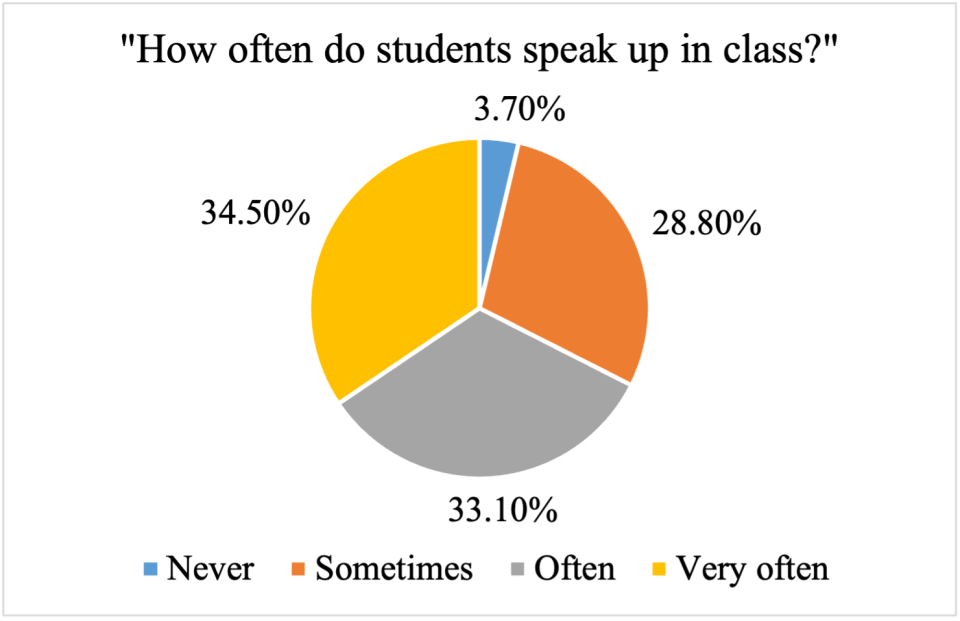
Many students learn best when they feel part of a community. However, a substantial proportion still speak up in class only sometimes or not at all. About a third of students fall into this group when asked about contributing to class discussions, according to the 2024 Community College Survey of Student Engagement (see figure 1 below). Students might feel less confident about when and how to contribute, particularly if they became accustomed to more passive forms of engagement. Creating a sense of belonging and shared purpose can help lower this anxiety and make participation feel more natural.
One of my favourite ways to build community, and reduce students’ feeling of being isolated in a crowd, is through a stock-trading simulation where teams manage virtual investment portfolios. Each group researches companies, debates which stocks to buy or sell, and tracks their performance over weeks. This activity fills the classroom with analysis, laughter and friendly competition. What I value most is how it supports students who might otherwise remain silent. Working in small teams removes the pressure of speaking in front of the whole class and gives hesitant students a safer space to share ideas and ask questions. As they justify decisions and listen to different viewpoints, students build confidence in expressing themselves. Through collaboration, students discover that complex problems are best solved together, and that learning as a community is both rewarding and empowering.
4. Bring theory to life
Effective teaching bridges the gap between abstract concepts and real-world experience. One of our most important roles as teachers is to help students grasp complex ideas in a clear and accessible way. I believe theory only becomes meaningful when students experience it. By connecting academic content to real-life situations, I help students develop deeper understanding and lasting curiosity about the subject.
In my classes, I strive to make learning an interactive experience rather than a passive lecture. Finance can seem abstract, but it becomes much more engaging when students see how theories apply to practical decisions. For example, when introducing agency theory, I invite students to role-play as shareholders, managers or regulators. While these activities often begin with laughter, they quickly evolve into thoughtful debates about incentives, trust and decision-making. Watching students argue, negotiate and even joke their way through challenging scenarios is far more rewarding than any PowerPoint slide or lecture note.
Every effort to listen to, care for, connect with and inspire students helps university educators create a classroom where learning feels genuine and alive. Over time, I have come to see that a supportive environment does more than encourage participation. It helps students find their voice and reminds teachers of the deeper purpose behind our work.
Yongjia Lin is a professor in the School of Business at Macau University of Science and Technology.
If you would like advice and insight from academics and university staff delivered direct to your inbox each week, sign up for the Campus newsletter.



comment