


If you were starting from scratch in 2023, how would you design a university technology transfer office (TTO)?
The question assumes two conditions that increasingly characterise higher education: an unknown pipeline of opportunity, and the need to operate at very low cost. This is not a situation in which an established model can simply be scaled. Instead, it requires an office designed to surface, evaluate and advance value where outcomes are uncertain, resources are constrained, and conventional markers of commercial potential may not yet be visible.
Although the immediate focus was on building a TTO oriented towards arts and creative practice rather than a traditional STEM pipeline, the underlying challenge is not discipline-specific. Ambiguity, experimentation and limited capital shape innovation across sectors. Any effective contemporary TTO must be capable of operating within uncertainty, rather than treating it as a problem to be eliminated.
- Spotlight guide: Making the case for arts and humanities
- The foundations of a successful knowledge transfer partnership
- How a career framework for knowledge exchange can foster a culture of professional growth
The model described here avoids reinventing infrastructure. Instead, it positions the TTO to engage selectively with short- to medium-term national initiatives, funding calls and grant-funded programmes as they arise. These external interventions bring time-limited resources, specialist networks and established frameworks. By collaborating rather than duplicating effort, the office can access this capacity cost-effectively. Its core function becomes one of alignment: connecting emerging creative activity to external opportunities, adapting as funding cycles change, and retaining learning and data as initiatives begin and end.
The TTO sits between external partners and emerging internal pipelines (see Figure 1), brokering relationships, absorbing weak signals and using evolving data to inform where value may be forming next.
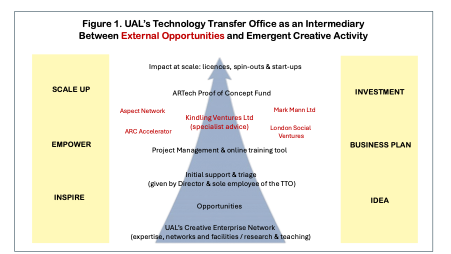
Proof of concept: the shared technology transfer office pilot
This approach has already been tested. A six-month pilot of a shared TTO, hosted by the University of the Arts London (UAL), under real operating conditions, demonstrated that consultancy-style support could open a route to specialist commercialisation expertise without building permanent in-house capacity. External support is introduced only when the emerging pipeline warrants it, allowing early-stage ideas to develop without the burden of premature overheads. As opportunities mature, value is generated not only for the university but also for external partners.
UAL established working relationships with Kindling Ventures Ltd, a company with extensive experience within university TTOs that also understands the sector and – critically – the working methods and motivations of academic and creative practitioners.
In this sense, the shared TTO pilot, which was supported by a Research England grant, offers a concrete example of how a lean, collaborative office can eliminate the risk of early-stage discovery, leverage external capability, and build durable partnerships – while remaining adaptable to shifting funding landscapes.
Emerging pipeline, external investment and cost discipline
Although UAL has a long-established pipeline of student start-ups supported by internal and external incubators, academic staff only began to develop their own opportunities in 2023 with the foundation of UAL’s TTO. For this reason, while the office supports opportunities from both students (mostly by referral from incubators) and academic staff, the data on opportunities from academic staff, when viewed alone, provides an accurate measure of the growth and emerging character of UAL’s contemporary TTO.
Over 30 months, the number of identified opportunities from academic staff has grown significantly (Graph 1). What began as a diffuse set of early-stage enquiries has developed into a structured and increasingly legible pipeline. Within this expanding resource, a defined subset has progressed into active projects with clear potential for high impact, allowing attention and resources to be focused without narrowing the overall field of exploration.
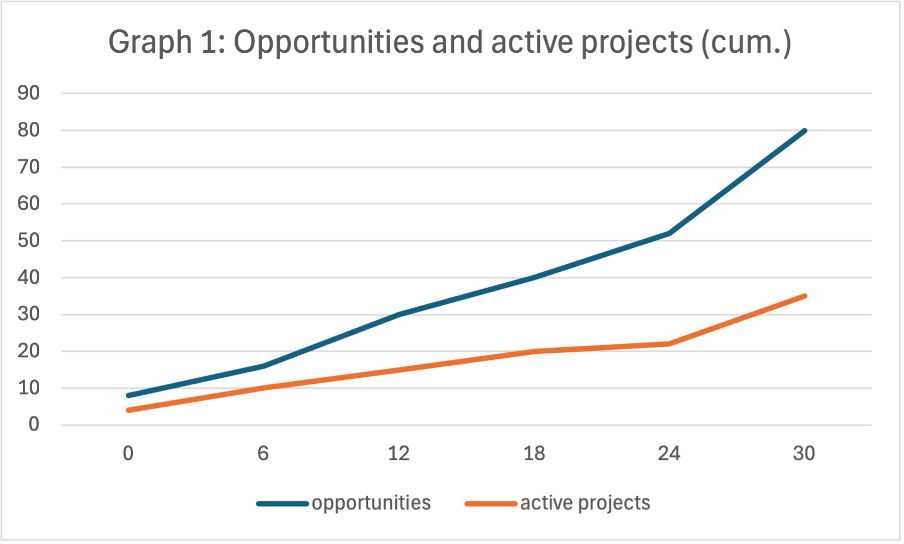
As the pipeline has matured, the character of opportunity has become more distinct. Activity has clustered into recognisable modes of value creation, including licences (such as copyright or patents), services, spin-outs (based on intellectual property or research developed within the university) and start-ups (created independently but growing in association with the university). This differentiation was not imposed in advance; rather, it emerged through engagement, testing and iteration, allowing creative practice to determine its own routes to value instead of being forced into predefined commercial categories. Services and start-ups have surged into predominance, which appears to be a defining characteristic of an arts university opportunity pipeline, in contrast with STEM university pipelines, which typically show a stronger bias towards spin-outs. This insight helps UAL’s TTO to optimise the support it provides to academic staff.
Crucially, this growth has occurred while maintaining a low and stable direct cost base for the TTO itself. Rather than scaling permanent staffing or fixed programmes in anticipation of demand, the office has remained deliberately lean, prioritising responsiveness and selective intervention. At the same time, significant external funding has been secured through competitive grants and national initiatives. External funds have increased, to nearly £800,000 over 30 months, in parallel with pipeline growth, both subsidising core office operations and directly supporting project development.
This combination of cost discipline and external investment fundamentally alters the economic logic of the office. Operational cost is no longer treated solely as a fixed institutional overhead, but is partially offset through alignment with external funding cycles. The TTO functions as a conduit for inward investment, translating emerging creative activity into fundable propositions while retaining learning and capability within the institution. Impact is therefore scaled not by expanding infrastructure but by leveraging insight, partnerships and timing, deploying internal resources only where signals justify deeper commitment.
A technology transfer office that operates as a catalyst
While the TTO’s processes are designed to enable scaled impact over time, they are equally committed to nurturing and empowering student and academic entrepreneurs. Through interaction with both the TTO and its external partners, entrepreneurs gain confidence, experience and critical understanding, not only of how value may be realised but of how it is recognised, articulated and tested beyond the university.
External specialists play a distinctive role as translators between creative practice and wider markets, policy frameworks and funding ecosystems. These insights feed back into career ambitions, teaching and research cultures, strengthening pedagogy and equipping the next generation of entrepreneurs and employees with a more realistic and resilient understanding of professional practice.
Engaging external expertise in this way is not simply a matter of cost control. It is a design principle that allows the office to remain lightweight while still accessing deep, current knowledge across rapidly shifting sectors and funding landscapes. Rather than embedding fixed capacity in anticipation of demand, the TTO orchestrates internal talent and external capability dynamically, committing resources only when evidence justifies deeper engagement.
In this way, the TTO operates not simply as a commercialisation mechanism but as a catalyst. It brokers relationships and builds institutional capacity for discovery, experimentation and value creation under conditions of uncertainty. Its effectiveness lies not in self-sufficiency but in permeability.
Gavin Clark is director of enterprise and commercialisation at the University of the Arts London.
If you would like advice and insight from academics and university staff delivered direct to your inbox each week, sign up for the Campus newsletter.


comment