


Laboratory teaching is a vital part of science education, but it is also one of the most resource-intensive elements of it. Every practical class carries environmental costs: solvents, consumables, energy, water, equipment time, staff workload and travel.
The answer is not to remove practical work. Students still need to handle equipment, troubleshoot experiments, interpret real data and experience the discipline of the laboratory. But we should ask a more useful question: how much of what happens in a teaching lab genuinely needs to happen there for the first time? Virtual reality (VR) can shift familiarisation, rehearsal and decision-making out of the physical laboratory and into a reusable digital space.
Start with the most wasteful moments
In many practical classes, waste is created before the experiment really begins: students are unfamiliar with the room, unsure how equipment works, unclear about the sequence of steps, or nervous about making mistakes on expensive instruments.
Audit one laboratory session and ask:
- Where do students make repeat mistakes?
- Which steps require repeated demonstration?
- Where are consumables or solvents wasted?
- Which instruments are heavily booked?
- Which sustainability instructions are understood too late?
These are the strongest candidates for VR activities.
Use virtual reality before the lab, not instead of the lab
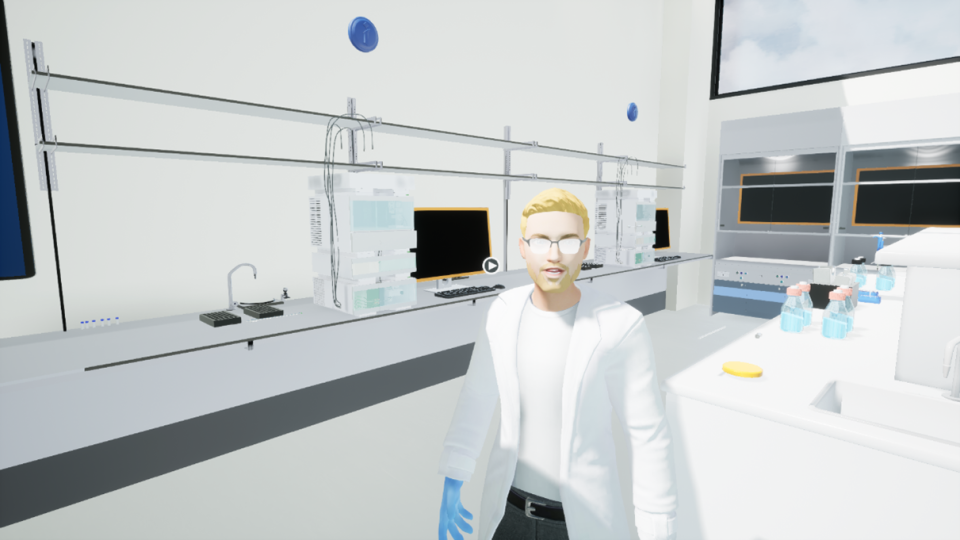
The most useful VR laboratory activity is often short. A 10- to 15-minute pre-lab simulation can give students a structured route into an experiment before they enter the physical teaching space. In analytical science teaching, students need to understand solvent reservoirs, sample preparation, column selection, autosampler use, waste routeing, sequence setup and data interpretation before they can meaningfully use a high-performance liquid chromatography (HPLC) system. Much of this can be introduced virtually before students touch the real instrument. In our VR pre-lab task, students can identify key components, practise the workflow and make low-risk mistakes without consuming solvent, generating waste or occupying limited instrument time. Staff can then spend less time repeating orientation and more time supporting troubleshooting, interpretation and scientific reasoning.
Build sustainability into the task
Sustainability messages are often placed around the laboratory: a poster about solvent waste, a reminder to switch equipment off or a paragraph in a handbook. VR allows those decisions to become part of the task itself. Instead of simply telling students to reduce waste, ask them to practise greener choices. They might select an appropriate solvent volume, check whether a waste container is correctly labelled, decide whether an instrument needs to remain running or work out what to do when a sample has been prepared incorrectly. Link these choices to short prompts explaining the consequence.
- Spotlight guide: Greener lab practices in higher education
- Go green, AI!
- Greener life science labs - the challenge to save energy and reduce waste
Design the simulation around decisions, not decoration
A common mistake is to make VR visually impressive but educationally thin. The strongest virtual laboratories are not simply digital rooms to walk around. They give students meaningful decisions to make. Ask what students should be able to do differently after the VR activity. Should they enter the lab knowing the equipment layout? Should they identify the correct waste route? Should they understand why poor sample preparation leads to repeat analysis? Once the learning decision is clear, the VR design becomes simpler.
Involve technicians and students early
Technicians often know where laboratory teaching becomes inefficient. They see which instructions are misunderstood, where queues form, where consumables are wasted and which equipment students find intimidating. Their insight should shape the VR scenario from the start. Ask students whether the simulation reduces anxiety, improves confidence and helps them understand the practical before they enter the laboratory. Simple evaluation is enough: confidence before and after the VR activity, common errors in the practical class and staff observations.
Reuse and share digital twins globally
The sustainability value of VR increases when we reuse digital environments. A virtual HPLC suite, good manufacturing practice (GMP) training room or a formulation laboratory can support multiple cohorts, modules, departments and partner institutions. This reduces duplication and makes specialist training available to students who may not have local access to the same equipment.
Shared virtual laboratories can also support international collaboration. They allow students and staff in different locations to work with the same training environment before meeting physically. This does not replace local practical experience, but it can reduce unnecessary travel for orientation, demonstration and early-stage collaborative teaching. AI avatars can support virtual laboratories by answering questions, guiding workflows and offering multilingual support. But AI is not environmentally neutral, so use it selectively: for contextual help, adaptive prompts or support outside scheduled teaching time, not simply for reading out instructions.
VR will not make laboratory teaching sustainable on its own. But when it targets avoidable waste, prepares students for real experiments and shares specialist training environments, it can make practical science more efficient, inclusive and sustainable. The future is not virtual laboratories replacing real ones. It is a smarter cycle between the two: students rehearse digitally, experiment physically and return to VR.
More tips for using VR in the lab
- Keep the first version small. One instrument, one workflow and one repeated student mistake is enough for a useful first VR activity.
- Do not build a virtual laboratory tour. Build a task. Students should have to make decisions, not just look around.
- Make the VR activity compulsory but short. A focused 10-minute pre-lab task is more likely to be completed and valued than a long optional simulation.
- Use technician knowledge. Technicians know where students queue, spill, misunderstand instructions or waste materials.
- Connect VR to practice. Use the same language, equipment layout, workflow and decision points students will meet in the physical lab.
- Add sustainability prompts at the moment of action. For example, when students choose a solvent, load a sample, select a waste container or repeat a run.
- Measure simple outcomes. Track confidence, repeated questions, avoidable errors, staff observations and student feedback before and after introducing VR.
- Avoid overusing AI. Use AI avatars for contextual support or multilingual guidance, not for instructions that could be written clearly on screen.
- Plan for reuse from day one. Build the digital twin so it can be reused across cohorts, modules, outreach sessions or partner institutions.
- Keep the message clear: VR is not the outcome. Better-prepared, greener and more inclusive laboratory teaching is.
Stephen Hilton is VR lead in the School of Pharmacy at UCL. Blanka Hilton is VR lead for the science degree apprenticeship in the School of Biosciences at the University of Kent.
If you would like advice and insight from academics and university staff delivered direct to your inbox each week, sign up for the Campus newsletter.

comment