

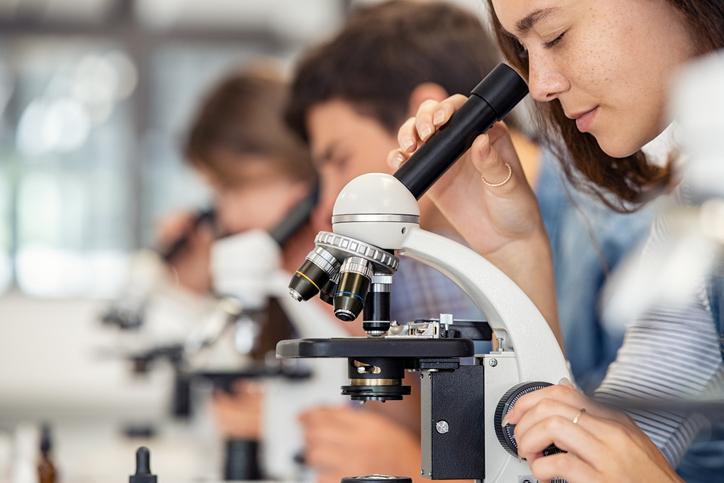
Sustainable development at regional levels needs more than technological solutions. It depends on a culture of research and innovation, combined with an educational system that supports critical thinking. Our university’s Joy of Science initiative addresses this need by using STEM education as an instrument of empowerment in the region of South-Muntenia, Romania. Through interactive learning, hands-on experiments and collaborative research mini-projects, the Joy of Science initiative trains young people to identify and address real problems in their local environments.
As part of this, the BuStIng – Joy of Science in the South‑Muntenia Region project integrates science caravans that bring laboratory demonstrations directly to schools across the region, thematic competitions that stimulate curiosity and creativity, and a Joy of Science Week where students explore STEM topics through guided experimentation and interactive lectures. We strengthen hands-on learning through laboratory-based sessions, in which school pupils work alongside researchers and university students to apply theoretical concepts in real experimental setups, developing technical skills and critical thinking in the process.
- Snails, Jaffa Cakes and rubber ducks: making university outreach playful
- Spotlight guide: The secrets of successful university outreach
- Unlocking minority students’ potential with an asset model approach
Educators and researchers lead collaborative mini-projects of mixed teams of pupils and students to co‑create small-scale investigations or educational resources – an approach that not only modernises science communication, but also builds a functional bridge between pre-university education and the academic research environment. The project further promotes innovation by developing open-access educational materials and by ensuring broad participation, including rural schools. This reduces regional educational disparities and aligns STEM engagement with South‑Muntenia’s development priorities.
Responding to regional priorities such as energy efficiency, waste reduction or digital inclusion, the Joy of Science initiative addresses specific challenges: disparities in education quality, limited access to modern laboratory infrastructure, and a low uptake of digital and technological tools in schools — all factors that influence students’ readiness for STEM pathways.
Its interactive experiments and educational resources range from environmental monitoring, such as air‑pollution measurement, and food‑safety investigations to material‑durability testing, digital microscopy and renewable‑energy demonstrations, such as the fruit‑based biobattery. All these provide students with practical means to explore real‑world problems.
These activities help them understand environmental health risks, overcome low scientific literacy and engage in community‑oriented innovation projects. In doing so, the programme reflects and contributes to the region’s strategic goals of improving public health and well-being, cultivating green skills, accelerating technological adoption and fostering meaningful youth involvement in local development, ultimately contributing to South‑Muntenia’s long‑term sustainability and resilience.
The Joy of Science initiative is designed to pique interest in research among students and teachers in the local region, by fostering curiosity and collaboration. This is how it’s structured:
Creating a participatory ecosystem
We created a participatory ecosystem by partnering closely with schools, teachers and local communities, ensuring that scientific knowledge circulates in both directions – from university laboratories to classrooms, and back through local feedback that continuously refines our activities.
To initiate this, we relied on existing regional analyses that had already highlighted gaps in laboratory access, digital readiness and STEM engagement, and complemented them with ongoing feedback from local educators. This two‑way flow of knowledge ensured that each intervention remained closely aligned with the documented needs of the South‑Muntenia region.
Interactive and experiential learning formats
The first step was piloting science caravans in three counties, to test logistics, mobility and interest levels. Teachers helped select age‑appropriate experiments and coordinate student participation. Based on the positive reception, the caravans were scaled up region‑wide. Science Week and other thematic competitions were similarly developed through collaborative interactions where teachers proposed various themes linked to students’ everyday experiences.
The challenge was ensuring equal participation across rural schools with limited space and facilities, and transporting delicate or too heavy laboratory equipment safely across long distances.
Hands‑on laboratory sessions and co‑creation experiments
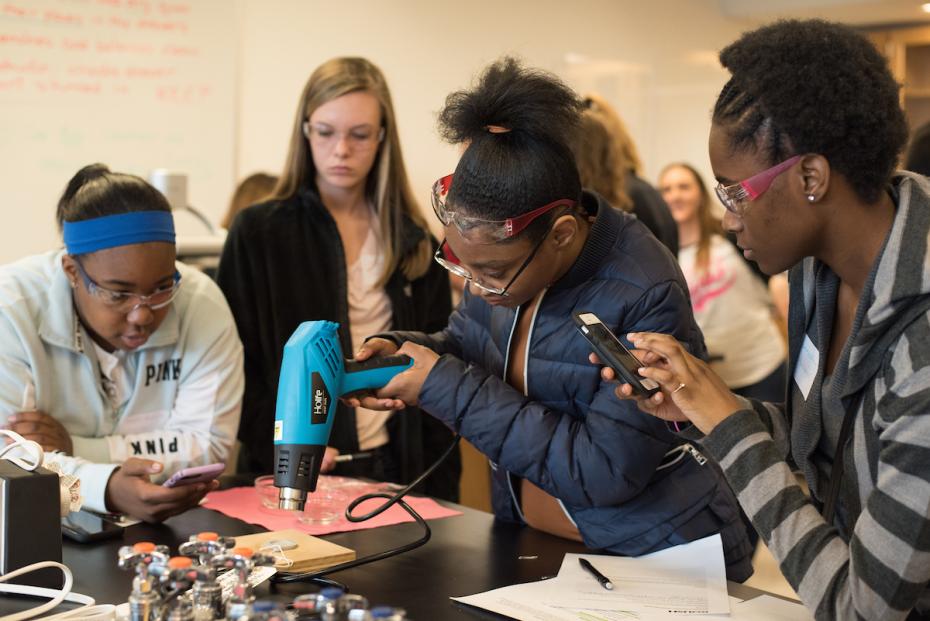
We began by opening university laboratories to pupils on a scheduled Science Week. Researchers volunteered to run simplified experiment modules that could later be replicated in schools. Gradually, we transitioned from demonstration-based sessions to co‑creation sessions, where students could design small parts of the experiment themselves, such as formulating hypotheses, selecting variables or interpreting data. Challenges were here related to aligning experiment complexity with students’ prior knowledge, as well as coordinating schedules between researchers, university students and high‑school classes.
Innovative digital and educational resources (ongoing activity)
To build these resources, we formed mixed working groups of teachers and researchers who collaboratively produced lesson templates, experiment guides, digital worksheets and video tutorials. These materials are meant to be tested in classrooms, refined through feedback and then uploaded as open educational resources on the university platform. The obstacles we faced here included differences in digital literacy among teachers, ensuring that materials may be accessible on low‑bandwidth connections used in some rural communities, and also aligning resources with the national curriculum to ensure usability in formal teaching.
Mixed teams and cross‑sector partnerships
We started by inviting local businesses, public institutions and NGOs to join the ecosystem from the earliest stages. Their involvement included participation in evaluation panels for competitions, offering mentorship to students, providing equipment or logistic support and joining dialogues about regional research needs. This cross‑sector cooperation helped embed the initiative in broader community priorities. We did have to factor in partners’ available time and resources, as well as the importance of developing a shared vocabulary between educators, researchers and business partners.
We’re hoping this process will generate long-term benefits, including an expanded pipeline of motivated local young people entering STEM programmes; stronger links between university labs and schools, leading to the adoption of research practices and hands-on methodologies in school classrooms; and making sure our research stays relevant for society, by integrating real-life issues into our work.
We strengthen their research‑management capacity by training academic teams in authentic, real‑world contexts, such as coordinating science caravans, managing laboratory‑based workshops with pupils and co‑developing educational resources with teachers. These activities require academics to plan logistics, adapt experiments for non‑specialist audiences and collaborate across institutional boundaries – all core elements of applied research management. This approach integrates outreach and educational components into our research strategies while allowing us to track how scientific activities resonate beyond academia.
At the same time, for research to impact on regional societies, increased scientific literacy among young people and their educators is crucial. We need to make sure our research and educational content aligns with the needs of the local labour market in STEM sectors. Plus, we have a responsibility to raise awareness of sustainability challenges and offer technological solutions.
Our experience of the Joy of Science initiative shows how research management and STEM education can mutually reinforce each other to create a model where science is not confined to laboratories, but extended into communities, schools and everyday life.
Cristina Mihaela Nicolescu is a research scientist and Marius Bumbac is a lecturer, both at Valahia University of Târgoviște, Romania.
If you would like advice and insight from academics and university staff delivered direct to your inbox each week, sign up for the Campus newsletter.

comment