


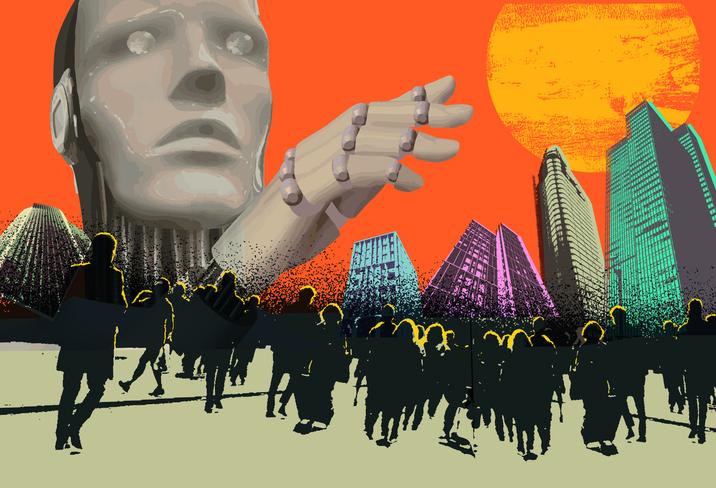
Young people have become more interested in dystopian narratives in recent years, research has found. Students of all ages and backgrounds watch dystopian films and TV shows, play dystopian video games and read dystopian fiction. Increasingly, they bring this interest into the classroom where they inevitably encounter real-world dystopian markers that remind them of the proximity of dystopia today.
We don’t always see the same interest in utopian visions. Few remain subscribed to the idea that capitalism can offer utopia, something that seemed possible during moments in the 19th and 20th centuries. But this hasn’t been the starting point for new ideas of what might replace it. Instead, so-called capitalist realism – the perception that, as Fredric Jameson put it, “it is easier to imagine the end of the world than the end of capitalism” – has now become endemic. Imagining better worlds has never seemed more difficult.
As educators, should we be afraid of the rise of dystopia in the post-truth age, or should we view it as an opportunity to cultivate critical thinking and to better understand the present and tomorrow? Between us, we’ve spent nearly a decade teaching utopian and dystopian fiction, science fiction and speculative fiction in higher education. Here is advice based on what has worked for us.
Start with something short and provocative
For example, have students read extracts from Thomas More’s Utopia and put them in groups to agree on a vision of a “better world”. It’s the most fun you can have in a classroom, and proof that studying utopian fiction doesn’t have to be dull.
Ask foundational questions about trade-offs relating to freedoms, privacy, individuality and equality
Can a utopia exist at the same time as inequality? What freedoms would you be prepared to sacrifice for a fairer world? What is the link between prosperity and happiness? Is utopia collective or individual? Try Ursula K. Le Guin’s short story The Ones Who Walk Away from Omelas. This five-page story allows for rich and insightful discussion on happiness, choice, justice and responsibility.
You can also introduce excerpts from dystopian fiction or scenes from screen adaptations. Thematic organisation into topics such as dystopia and surveillance, censorship, population, gender, technology, climate change and social class helps students navigate the course more seamlessly.
Give students tailored themes or study questions to discuss. Ask them to write page-long responses or opinion or reflection papers to help them engage more critically with the works. Alternatively, you could ask them to write shorter blog entries. Ask them questions such as “Would you want to live in the society portrayed? Why or why not?”
Ray Bradbury’s Fahrenheit 451 is a good prompt for discussions on why we should not be burning books. P. D. James’ The Children of Men and Alfonso Cuarón’s screen adaptation are great resources for discussions on population, pandemics, migration, sacrifice and hope. Students always find Black Mirror, the technological dystopian series, captivating. The episode Hated in the Nation is a great prompt for discussions on dystopia, technology and surveillance. The film Snowpiercer and Kim Stanley Robinson’s novel The Ministry for the Future offer insight into multiple aspects of climate change, sustainability and environmental problems in general. Ultimately, the aim is to foster critical thinking through dystopia. Let students contemplate the present and the future.
- Spotlight guide: Critical thinking in teaching and research
- GenAI can help literature students think more critically
- A little more conversation: using Elvis to teach critical theory
Keep it relevant, but don’t validate students’ cynicism
When studying utopian and dystopian fiction, students tend to come for the dystopia but leave with a much greater interest in, and understanding of, utopia. It is worth starting with utopia, not only because it’s foundational, but also because it’s what challenges students most. Students nearly always view the idea with cynicism. It is common to hear them ask, “Isn’t one person’s utopia just another person’s dystopia?” But if that were the case, society would never move forward. There must be some things we can all agree on that would make the world a better place.
Being cynical is easy, and tempting, but it doesn’t get us far. We need to imagine other worlds, so talk to students on their level and engage with them on the subjects shaping society today, but always offer an alternative, positive vision. Short stories, such as E. M. Forster’s The Machine Stops, for example, have never seemed more relevant with the advent of artificial intelligence, but teach them as “critical dystopias” designed to give hope that we can resist slipping into dystopia.
Highlight the hope in dystopian narratives
Today’s world is full of complexities and ambivalences, particularly for young people finding their feet. Utopian and dystopian narratives offer valuable perspectives and visions. We should hold on to and emphasise hopeful moments even in dystopian narratives. As educators, we need to make students think more critically about both the world we are living in and the one we want to live in tomorrow.
Matthew Leggatt is senior lecturer in English and American literature at the University of Winchester. Emrah Atasoy is heritage collections postdoctoral research fellow at the University of Edinburgh’s Institute for Advanced Studies in the Humanities and associate fellow of the University of Warwick’s Institute of Advanced Study and of English and comparative literary studies.
If you would like advice and insight from academics and university staff delivered direct to your inbox each week, sign up for the Campus newsletter.


comment