

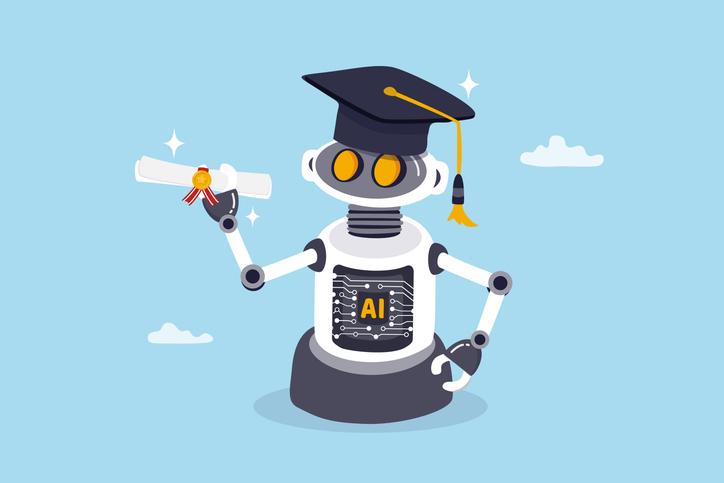
It’s people, not technology, who change institutions. Human-centred GenAI means designing, deploying and governing its use in ways that enhance – not replace – human judgement, relationships and agency across teaching, learning and academic leadership. It shifts the narrative from automation to augmentation. We want technology to strengthen the core human purposes of education: critical thinking, creativity, ethical reasoning and inclusive learning.
This understanding has shaped the first phase of my university’s approach to GenAI. Our starting point was a faculty-wide survey to gauge how instructors were already experimenting with the technology. The responses revealed genuine interest but uneven readiness across departments.
- AI tools that strengthen students’ communication skills
- Solving the soft skills crisis using artificial intelligence
- GenAI as a research assistant: transforming start-up due diligence
To move beyond individual enthusiasm, we created a faculty AI readiness self-assessment, now being rolled out across all academic units. It examines five interconnected dimensions: GenAI literacy, pedagogical integration, curriculum design, student engagement and ethical use.
The aggregated results will guide our targeted development programmes for 2025-2030 and ensure that no academic area is left behind as GenAI capability expands.
This focus on people is also why we’ve launched the Generative AI Resource Center. The hub brings together curated tools for course design, assessment and student support; discipline-specific use cases; ethical guidelines and training resources, including options for certification. Together, these initiatives encourage exploration while keeping pedagogy and ethics at the forefront.
An institution-wide effort
For the past two years, I’ve been involved in shaping my institution’s strategic direction on GenAI in teaching and learning, and I currently chair the university-wide AI Across the Curriculum task force, examining how GenAI should be used in teaching, as well as how we can build a sustainable model for alignment across the institution.
We wanted to clearly distinguish between strategy, policy and governance. Strategy sets direction, policy establishes boundaries and governance ensures that implementation remains responsible.
Those distinctions have prevented us from racing ahead technologically yet lagging behind in scholarly or ethical readiness. They have also given us a shared vocabulary as we work toward campus-wide adoption.
An AI across the curriculum approach
Much of our thinking draws on research I presented in my paper “AI without borders” at the AIET 2025 conference in Munich. I examined GenAI’s global reach across languages and cultures and highlighted its capacity to bridge divides between face-to-face, online, hybrid and mobile learning.
This research underpins our plans for real-time translation, adaptive feedback mechanisms and multilingual chatbots – all initiatives designed to widen access to learners traditionally underserved by global education systems. These ambitions will now feed into our evolving vision of what a smart liberal arts university could look like by 2030.
Building GenAI literacy for all
We chose general education as the entry point for embedding GenAI because it is a common academic space that every student passes through. Rather than bolt on GenAI as a technical addition, we are integrating it into existing learning outcomes that emphasise critical thinking, ethical reasoning and digital literacy.
We are also strengthening these outcomes through a focus on GenAI literacy, technical awareness, ethical judgement and the ability to critique or co-create using GenAI tools.
Two required computing courses support this progression, introducing students to internet culture, data ethics and hands-on experimentation with tools such as ChatGPT, Scikit-learn and Google Teachable Machine.
These courses help students practise prompting, evaluate GenAI outputs and build simple GenAI-supported projects, with micro-credentials enabling us to track literacy development over time.
By the time students advance in their majors, they have already encountered GenAI in a structured and ethically grounded way.
Accessibility, inclusion and GenAI for the common good
Our work is shaped by Morocco’s geographical and sociocultural context, particularly the need to narrow disparities in access. Recent projects include:
- GenAI-assisted sign language interpretation
- Tools for visually impaired learners
- Automated multilingual FAQ chatbots for student services
- GenAI-supported service learning initiatives addressing real community needs
With careful attention to cultural sensitivity, bias and data privacy – concerns central to my own research – GenAI can be used effectively to reduce rather than widen inequalities, especially in regions where digital divides persist.
Rethinking assessment in the age of AI
Assessment is emerging as one of the most complex areas of change. Traditional tasks are increasingly vulnerable to GenAI-enabled shortcuts yet the technology also opens the door to more authentic, skills-focused assessment.
Our task force is currently collaborating with faculty to consider an institution-wide re-examination of assessment norms, including how to ensure assessments remain meaningful; where and when AI can support feedback or grading; and how to design tasks that promote creativity, critical judgement and ethical reasoning.
We are not promoting templates or prescriptive formats. Our goal is to support departments in exploring approaches that preserve academic integrity as they embrace innovation.
This work aligns with international standards we have adopted, including UNESCO’s AI ethics recommendations, the European Union’s AI Act and OECD AI Principles – frameworks that emphasise transparency, human oversight and equity.
A model other universities can adapt
Our experience so far highlights several key lessons for institutions embarking on similar journeys:
- Start with shared definitions. Clarify the difference between GenAI strategy, policy and governance early to avoid fragmented implementation.
- Use a common curricular space. Embedding GenAI literacy in general education provides equitable exposure across disciplines.
- Invest continuously in faculty development. Readiness varies widely. Deploy diagnostics, micro-credentials and innovation labs to help meet everyone's needs.
- Anchor efforts in ethical and global frameworks. Unesco, EU and OECD guidance offers stability and legitimacy.
- Prioritise inclusion. Use multilingual tools, accessibility features and community-focused applications to reduce barriers.
- Reconsider assessment before circumstances force it. Assume GenAI’s presence and design assessments that foreground higher-order thinking.
As part of my university’s forward-looking approach to GenAI, this autumn I introduced a new course titled Digital Media in the Age of AI. The course equips students with essential skills to navigate a GenAI-transformed media landscape, helping them identify deepfakes, trolling and misinformation, and understand the ethical issues emerging around GenAI content. Through real-world examples and hands-on projects, students examine GenAI’s impact on elections, journalism, privacy and public trust. This is an important step in our commitment to preparing critical, informed and future-ready graduates.
Today’s students might be digitally fluent but it is our responsibility to help them become GenAI-literate, as part of a longer personal and career-aware journey. They also need to be ethically grounded and prepared for a fast-changing world.
We believe GenAI can enhance teaching, strengthen administrative processes and broaden access but it cannot replace the human relationships that define meaningful learning.
The task before higher education is not to adopt GenAI uncritically but to cultivate a thoughtful and inclusive ecosystem. With care, collaboration and curiosity, GenAI can help reimagine, rather than diminish, the transformative possibilities of the university experience.
Abderrahim Agnaou is associate professor of communications and rhetoric at Al Akhawayn University, and serves as chair of its General Education Committee.
If you would like advice and insight from academics and university staff delivered direct to your inbox each week, sign up for the Campus newsletter.


comment