

Commercialising research is a challenge of timing, relevance and application. In essence: where is this new venture going to make a difference across sector(s) and society?
While both a typical start-up and academic spin-out involve launching a new venture, the difference for the latter is in the beginnings of the business and its ownership – or intellectual property (IP). A spin-out emerges from a university or research-focused institution, where the business offering is developed through experimentation and investigation over a period of time. As the institution usually owns the initial IP, the spin-out process involves a series of legal agreements and typically involves the parent institution having an equity stake.
- The first step in commercialising your research: start the conversation
- Plan your route from research to market
- The path from ‘eureka’ to patent
In contrast to this, a start-up usually begins with a sole entrepreneur, or small group, identifying a gap or opportunity in the market. So the IP in this case emerges and is often developed by the founders. Also, spin-outs must face high technical risk and experience the long lead times that are needed to move from prototyping to a commercial product or service.
While a start-up may focus on marketisation and seeking high levels of customer uptake as soon as possible, a research or academic spin-out requires significant capital for equipment, expertise and regulatory compliance before launch.
Spin-out strategies
Starting a spin-out means turning research breakthroughs into solutions that are ready for market and capable of real-world impact. Legal and regulatory steps for bridging the research-to-market gap include:
Firming the foundation
Crucial here is confirming the IP for all concerned, including relevant university offices, directors and business associates. Seek legal advice and outline shared goals in the early stages. By doing this, checks towards verifying that the research does not affect or infringe upon existing patents already listed can be completed – achieving a Freedom to Operate stage. From there, developmental funding to allow Proof of Concept can take place, including advancing prototyping and testing stages.
A responsive business structure
Appoint a distinct commercial lead who can help the business navigate the market and its complexities. Who can be that critical business partner along the way? They must confront and get agreement on terms, conditions and contractual agreements concerning levels of equity, ownership, business direction and decision making, and licensing.
Starting and scaling: marketisation
Before entry into the market, the positioning and narrative are vitally important. It should represent the research-informed offering in the best way possible. Focus on experimentation and investigation, from the initial stages of the new venture, highlighting what the business can offer and what it does.
However, the market demands solutions to existing problems or challenges. In essence, the marketing of the business should answer the “so what?” question. That includes referring to its value proposition, confronting current pains and putting forward future gains.
Finding investment
A spin-out is within that high-risk, high-reward bracket, so it is a challenge to secure large amounts of funding. Funders need assurances that the new venture is in response to robust, reliable and relevant research. The spin-out should also be able to outline how it aims to deal with the changing nature of the market and explain key strengths of the offering. This should encompass business feasibility and viability perspectives.
New ventures should be alert to what sources of funding are available and what is right for their business at that given time. Within universities and research centres, internal funding, for example, provides a great learning opportunity, regardless of the outcomes of the bid, towards future external funding calls. Sources of funding include:
- Non-repayable Proof of Concept grants
- Government grants, typically focusing on specific sectors or that may concern regional or wider socio-economical concerns or technological advancements
- University-linked, internal competitions or funding pots, which may involve private firms and expert venture capitalist professionals
- Angel investors and investor groups.
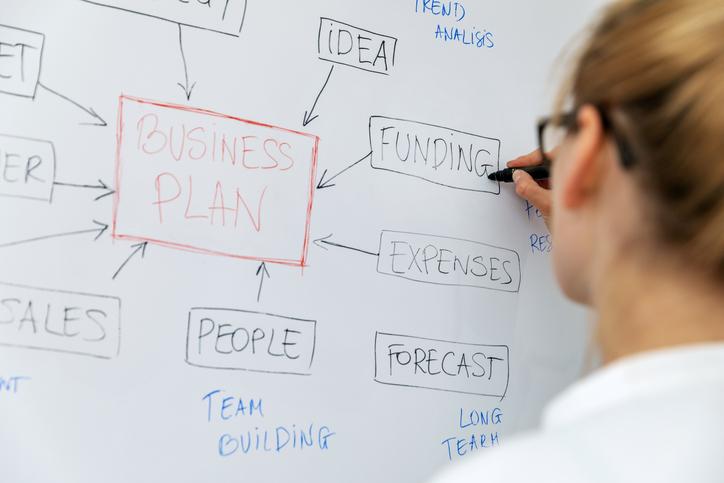
However, regardless of the type of business being proposed or prepared for market, you must be able to evidence a plan that charts a way forward to both financial viability and sector prosperity. Within a successful business plan, the following 10 elements must be addressed and explained:
1. Executive summary: Providing a clear snapshot of the company, the problem(s) being confronted, and the solution. In essence, what direct change can the new venture bring that is currently not available elsewhere?
2. Company description and unique selling points (USPs): Funders need to be told what the company does, where its key strengths and expertise lie, and the specific market it aims to serve.
3. Detailed market analysis: Industry insights and the role of the research-based spin-out. Funders need to understand the target market to ascertain desirability from potential consumers and society as a whole, and be able to place the new venture among competitors.
4. Leadership and know-how: Funding applications should reassure funders that the people involved are highly skilled and competent in dealing with this transition from research settings to the commercial world, and that the business structure reflects this.
5. The service or product line: Detailed breakdown of the offering and its life cycle. Funders like to see descriptions of the product and/or process, what it entails, and the features and benefits.
6. Marketing and sales strategy: Engagement with the customer and routes to realising revenue. What is happening, and when? Through what channels and how would success be measured?
7. Funding streams and desired amount(s): How much capital is needed over the next five years, and how will it be spent?
8. Financial projections: Forecasting revenue, expenses and cash flow.
9. Operations plan: The day-to-day logistics, from supply chains to customer face.
10. Appendix: Supporting documentation including patents, permits, plans and CVs.
Of course, while all of the above are necessary, investors and stakeholders will particularly focus in on IP strategy and arrangements, technical validation and practical milestones, bridging the gap through commercial leadership, and affirming the long-term “financial runway”. These are central towards the success of any spin-out, as they confront the purpose, protection, productivity and profitability of the new venture.
For success to be a reality, the spin-out has to be realistic in itself – of its potential limitations of market awareness, application and business modelling. With the business plan as the document “selling” the new venture, it is through clarity of its offering, collaboration with commercial expertise, and timely execution of strategy that enables us to cross the bridge from research to commercialisation.
Robert Crammond is senior lecturer in enterprise and director of the Transformative Enterprise Research Group at the University of the West of Scotland.
If you would like advice and insight from academics and university staff delivered direct to your inbox each week, sign up for the Campus newsletter.



comment