

The pattern repeats every year. A master’s or doctoral student proposes a systematic review, the supervisor agrees because it sounds contained, and six months later the project has consumed the calendar with nothing screened, nothing extracted and a defence date approaching. The data say this is the norm rather than the exception; an analysis of 195 registered reviews found the average took 67 weeks to complete and publish, with teams averaging five people. A student doing one alone, on coursework timelines, is attempting something the published record says usually takes a funded team more than a year.
Systematic reviews are still excellent student projects. They teach searching, appraisal and synthesis with rigour no narrative review matches. But they only fit inside a degree when the supervisor engineers the fit at the start.
Here is what that looks like in practice.
Scope the question to the calendar, not the literature
Most student reviews fail at the question. A question such as “interventions for anxiety in young people” can return tens of thousands of records; screening yields in published reviews range from a few hundred records to more than 90,000, and on average only about 3 per cent of what is screened ends up included.
- Evidence synthesis: what every student (and researcher) should know
- Europe invests in research but underinvests in forming researchers
- Using literature reviews to strengthen research: tips for PhDs and supervisors
Before approving anything, run the student’s draft search on one database and look at the number. A workable student review usually lives between 500 and 3,000 records. If the count is far beyond that, narrow the population, the intervention or the study design until it is not. This one hour of supervision saves more time than any other intervention available to you.
Require a protocol before any searching
A two- to three-page protocol – including question, eligibility criteria, databases, screening plan, extraction fields and analysis intentions – is the cheapest insurance in research supervision. It does not need formal registration to do its job, although registration teaches good habits. Its job is to surface the fatal problems, such as an unanswerable question or an extraction plan that assumes data the studies will not report.
Put three checkpoints in the diary on day one
Reviews do not collapse suddenly; they collapse quietly between meetings. Three scheduled checkpoints will catch almost everything early. They are ordinary supervision meetings rather than extra ones, and all three dates go in the diary at the first meeting, worked back from the submission deadline rather than fixed when the student says they are ready. First, the protocol review before any searching takes place. Second, a search and pilot screen check: the student screens the first 100 records against the eligibility criteria and you review their include and exclude calls, because misunderstood criteria discovered after 2,000 records means screening twice. Third, an extraction pilot on five included studies before full extraction, for the same reason.
Budget the hours honestly
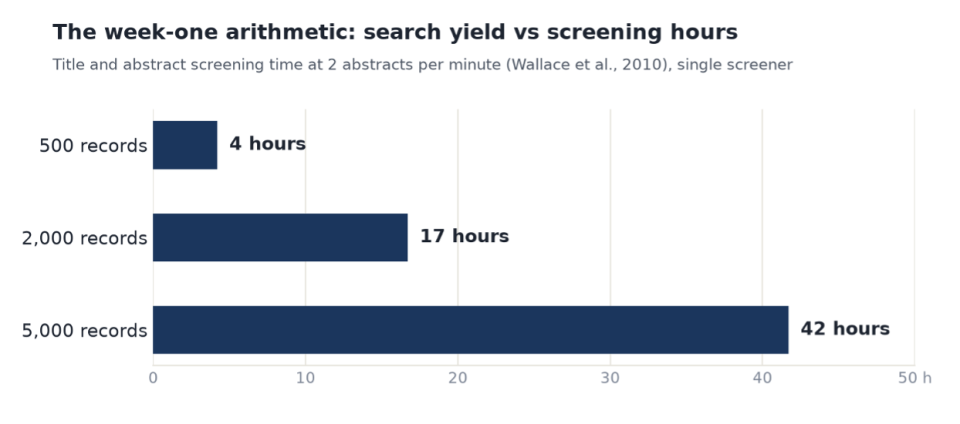
An experienced reviewer screens roughly two abstracts per minute. That number lets you and the student convert the pilot search count into real hours before committing: 2,000 records is roughly 17 hours of title and abstract screening before full-text review, extraction, appraisal and writing. Students who see this arithmetic in week one make sensible scope decisions. Students who meet it in week 10 make desperate ones.
Point students to free tools
Students routinely lose weeks to tasks that free software has already solved. Free screening platforms such as Rayyan manage deduplication and screening decisions. A browser-based PRISMA 2020 flow diagram generator produces the required flow diagram from the screening counts in minutes. Free tools exist for effect-size calculation and critical appraisal as well, including the ones my team maintains at Research Gold, which require no sign-up. None of this changes the intellectual work, but it removes the clerical failure modes, the lost spreadsheets and miscounted exclusions that surface in the viva.
Decide what ‘done’ means for the degree
The most important supervision conversation is about the finish line. A defensible thesis chapter is not the same deliverable as a publishable review, and pretending otherwise is how students end up serving the publication rather than the degree. Cochrane’s own guidance accepts rapid reviews with pragmatic shortcuts completed inside six months; a well-conducted scoping review is likewise a legitimate, examinable piece of work. Agree in writing at the start which deliverable the degree requires, and treat publication as a separate, optional project with its own timeline.
The weekly hour that makes the difference
None of this demands methodological heroics from the supervisor. It demands one structured hour a week, including the three diary checkpoints. Supervisors who spend that hour looking at the student’s screening decisions and extraction tables, rather than listening to progress summaries, catch the problems the summaries hide. The literature on completion is blunt: registered reviews are abandoned unpublished nearly half the time in some cohorts. The students who finish are rarely the ones with the cleverest questions. They are the ones whose supervisors made the question fit the semester.
Sarah Mitchell is a senior methodologist at Research Gold.
If you would like advice and insight from academics and university staff delivered direct to your inbox each week, sign up for the Campus newsletter.



comment