

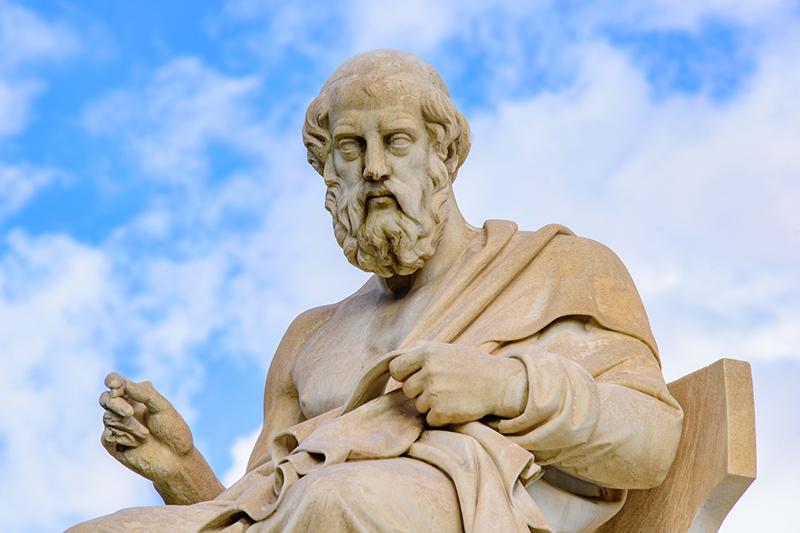
I blame Plato. In his philosophy, mathematics occupies a rarefied realm: timeless, perfect and largely untouched by the messiness of human culture. Truth, in this view, exists above history, above society and above people. This remarkably durable idea has helped foster a conception of mathematics, as austere and detached from ordinary human concerns, that continues to influence who is drawn to the subject and who is quietly pushed away.
This matters for universities because disciplinary images shape belonging. Perceptions influence participation. Students absorb implicit messages about what counts as legitimate mathematical thinking, who is likely to succeed and what kinds of intellectual dispositions are valued. When mathematics is framed as abstract, culture-free perfection, those who thrive on collaboration, creativity or contextual problem-solving may struggle to see themselves reflected.
Of course, I admire Plato. His philosophical writing has a rare imaginative reach, fusing argument, reason, myth and lyricism in a way that still shapes how philosophers embrace their craft today. More than any other figure in antiquity, he helped catalyse a moment in which mathematics and philosophy emerged as intertwined ways of seeking order and truth.
- Spotlight guide: Opening doors to greater diversity in STEM
- Make mathematics fun and easy to learn for university students
- How mathematical practices can improve your writing
Yet the Platonic image of mathematics has travelled far beyond its philosophical origins, shaping modern educational cultures and institutional norms in ways that were never inevitable and not always benign. It is an image that locates authority precisely at a distance from human contingency. Many philosophers and mathematicians note the philosophical costs of this ideal. It carries human ones, too.
The issue is not Plato, nor the extraordinary achievements of later figures such as Euclid, Apollonius or Archimedes. Rather, it is what happened to a particular strand of their legacy. Over time, one philosophical image of mathematics came to dominate: axiomatic, impersonal and detached from practice. Euclid’s Elements, with its austere deductive structure, was elevated into a universal model of mathematical reasoning. And largely lost in this were the surrounding practices: the heuristics, approximations, debates, errors and collective labour through which mathematics is produced.
Historians of mathematics have long shown that the discipline has never been culture-free nor driven by solitary genius alone. Across time and place, mathematics has taken many forms: algorithmic traditions refined across generations, numerical tables transmitted through scribes and commentary, procedures embedded in craft and commerce, diverse symbolic and diagrammatic styles of reasoning, distinct standards of proof and verification, to name only a few. These differences are not merely cosmetic; each mathematical practice has its own epistemic virtues, metaphysical commitments and truth criteria. The mathematics we publish and assess often looks very different from the mathematics through which we think, argue, revise and eventually understand.
The problem is that this richer reality seldom travels far beyond its own community. The stereotype persists. This mismatch between how mathematics is imagined and how it is practised has real consequences for who feels invited to participate.
So, what might it take to broaden the face of mathematics? The answer lies not only within our classrooms, but in how the discipline presents itself more widely.
What this means for teaching mathematics in universities
Long before students reach university, many have decided that mathematics is not a world in which they belong. So, as educators, we have a dual responsibility. Within the classroom, if and when students do reach us, we need to reinforce richer, more expansive images of mathematical practice. And beyond it, we must shift the wider perceptions of mathematics.
If disciplinary culture is deliberately designed, educators have choices. We can:
- Frame mathematics as a human activity: Use historical examples to show mathematics as something people do in response to real questions and constraints.
- Make process visible: Incorporate false starts, approximations and exploratory thinking – and not just final polished solutions – into lecture and tutorial discussions.
- Diversify assessment: Balance high-stakes, proof-heavy tasks with opportunities for modelling, collaborative problem-solving or reflective explanation of reasoning.
- Reward intellectual risk-taking: Signal that conjecture, questions and revising ideas are valued parts of learning, not signs of weakness.
- Value multiple mathematical voices and traditions: Draw on examples from different historical and cultural contexts to show that mathematical thinking has developed in diverse ways and is not the product of a single intellectual lineage.
- Position mathematics as a tool for engagement: Show how mathematical work can illuminate global challenges, from technological change to environmental sustainability, and invite students to see themselves as participants in those conversations.
These shifts do not lower standards. They clarify the breadth of what mathematical practice involves and widen the pathways through which students can engage in it.
But it is also important we do this outside our classrooms, too. We can use our public platforms, seminars, festivals, interviews and social media to showcase the vibrancy, diversity and curiosity that animate mathematical work. When colleagues, families and communities encounter mathematics in these broader, human contexts, they see a discipline that welcomes many modes of thought and participation.
Blaming Plato, then, is less about fault than about inheritance (and he is far from the only figure we could single out). To be sure, the philosophical image of mathematics is elegant and compelling. But the discipline’s history tells a richer story of collective labour, curiosity, dialogue, adventurousness and responsiveness to human questions. Diversifying STEM may therefore depend not on asking more people to conform to a longstanding philosophical ideal but on allowing mathematics to appear more generous, accessible and recognisably human.
Clemency Montelle is professor and head of the School of Mathematics and Statistics in the Faculty of Engineering at Te Whare Wānanga o Waitaha | University of Canterbury, New Zealand.
If you would like advice and insight from academics and university staff delivered direct to your inbox each week, sign up for the Campus newsletter.



comment