


As artificial intelligence education has been expanding, the focus has understandably fallen on technical skills: how models are trained, how data shapes outputs and how to design and use apps. These foundations, however, do not fully prepare students for the diverse environments in which AI is used. Graduates need to be able to communicate complex ideas to colleagues across disciplines and the public, writ large. Directness and responsiveness to diverse audiences are essential competencies that can be improved through experimentation with generative AI.
Contrary to the assumption that most students are “all in” on AI, I have found their attitudes and frequency of use far more varied. Some students enthusiastically embrace AI as another tool to employ in nearly every assignment but many others are deeply apprehensive, if not outright resistant. I recall one undergraduate who, on the first day of class when discussing the course’s GenAI policy, crossed her arms and said unequivocally that she would not use AI in the course.
Navigating students’ AI concerns
Often, resistance to AI use stems from legitimate concerns about the trustworthiness of its outputs, environmental impact, lack of transparency about how the models operate, unauthorised use of creative works as training data or bias in large language models (LLMs). The lines between process and product when using AI can be blurry, so we must support students as they define and voice this boundary for themselves and discern others’ views on this.
- Teaching ethics and sustainability through fiction
- How to support humanities PhD students with ethics applications
- How to navigate the grey areas of AI ethics
By asking questions and listening generously, we can help students articulate and interrogate such concerns, rather than pushing them to adopt new tools without regard for the personal principles they test. Unpacking specific use cases and exploring them in relation to values and context can equip students with the clarity, self-confidence and openness necessary to experiment with and benefit from AI on their own terms.
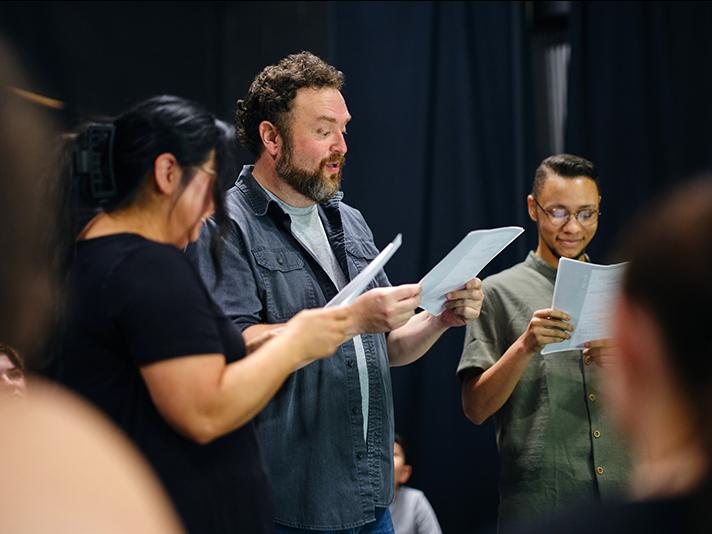
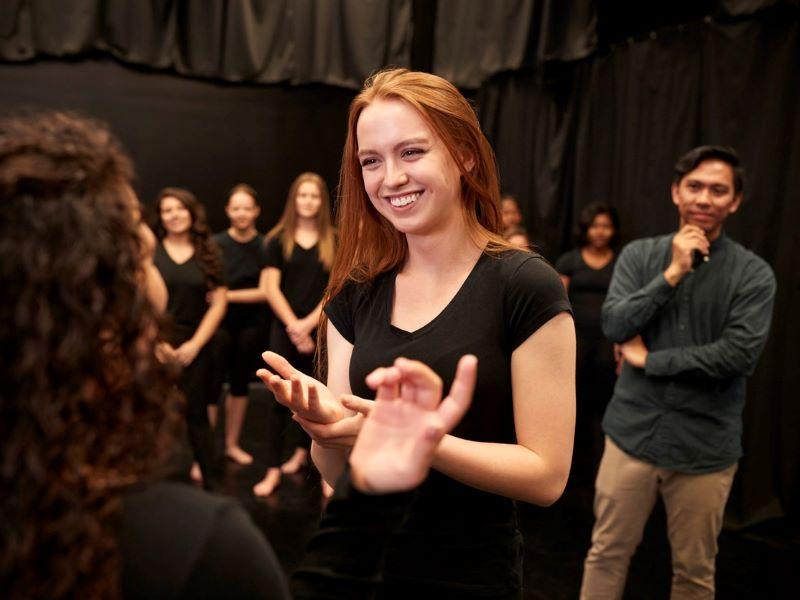
My background is in applied theatre and science communication – disciplines rooted in dialogue, spontaneity and human connection. Theatre might seem far from computer science but it offers tools to help students engage with AI beyond coding. Two strategies have proved especially effective.
The first draws on and adapts improvisational techniques described by CUNY professor Don Waisanen in his book Improv for Democracy. Students pick a sector – healthcare, education or law enforcement, for example – and list the potential benefits and risks of increasing automation within them. Reducing the “human in the loop” in education, for example, might free teachers’ time but weaken the social interaction necessary for learning.
Students adopt whichever side – benefits or risks – has the longer list and discuss it with a partner. This isn’t a debate. One student explains their reasoning through stories; the other responds with curious, non-judgemental questions. By rooting their viewpoints in personal narratives, students can drill down from arguing over abstractions and platitudinous opinions to a much more empathetic and productive level of conversation: examining when and how AI is affecting everyday lives. These discussions also yield dramatic “ingredients” for the later development of original scenes for exploring “what ifs” in AI design, use and policy. The goal is to practise listening, perspective-taking and thoughtful engagement with AI’s societal implications.
The second strategy uses GenAI itself. Students create imagined “personas” who they may find difficult to communicate with – a sceptical funder, say, or a vaccine-hesitant parent – and ask the chatbot to respond from that perspective. They then explain their research, answer the persona’s questions and defend their positions. The exercise forces them to consider audience perspective, refine their explanations and experiment with framing complex ideas in novel ways. This approach has its limitations, of course; while a chatbot can draw on a staggering amount of information to construct a believable persona, it might lack the layered and at times contradictory viewpoints of a person.
Using AI rather than human partners in this exercise, however, has been hugely beneficial because it removes the self-consciousness and limitations from lack of knowledge in person-to-person role-playing. It provides a low-stakes “container” for rehearsing interactions that could have high-stakes consequences in the future. Students focus on communicating clearly, while the AI’s responses reveal biases or uncritical agreement – creating opportunities to discuss underdeveloped ideas, research limitations and assumptions.
Both approaches rely on reflection and storytelling. By connecting personal experience, ethical questions and technical skills, students begin to see AI not just as a tool for boosting productivity but as a means for examining values, refining thinking and shaping society.
Practise, practise, practise
For universities seeking to strengthen students’ AI competencies, I say provide more opportunities to practise communication, perspective-taking and reflection. Applied theatre offers a range of concrete methods to cultivate these skills. By combining technical knowledge with structured conversations, students can learn to confidently navigate the complex social dimensions of AI.
Ultimately, the goal is simple: to produce students who understand AI technically, ethically, socially and practically, so they can be better prepared to contribute meaningfully in their fields. Applied theatre is just one approach but it’s a powerful one. When students create and engage with a GenAI persona, improvise a scenario or tell their story, they are not only learning about and with AI, they are rehearsing how to interact with the world as civic actors with the social fluency to improve the public good.
Jon Catherwood-Ginn is assistant professor of applied theatre in the School of Performing Arts and co-director of research for the Center for Communicating Science at Virginia Tech.
If you would like advice and insight from academics and university staff delivered direct to your inbox each week, sign up for the Campus newsletter.

comment