

Like many job descriptions, mine includes a familiar phrase: “Any other duties as required.”
However, I have recently gained a new appreciation of just how broad that statement can be. Over two days, “bush turkey wrangler” became part of my role.
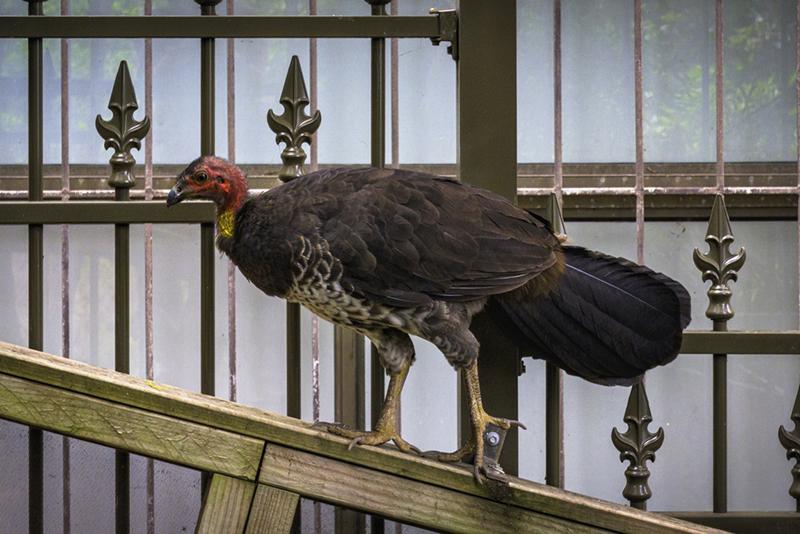
For those who have never encountered one, bush turkeys are imposing, prehistoric-looking birds with glossy black feathers, powerful legs, a bald red head and yellow throat wattle (see above). You’d know one if you saw it. While they can fly short distances when necessary, they prefer to strut around as though they own the place. They have adapted remarkably well to urban life, despite being native to Australia’s rainforests, and are a common sight around the Brisbane university campus where I work. They are particularly fond of turning carefully maintained gardens and mulch beds into enormous nesting mounds, much to the frustration of gardeners and grounds staff everywhere.
- Dreaming of tuī returning to campus
- Spotlight guide: Connecting the dots between academic and professional services staff
- Beyond bureaucracy: how to work with faculty professional services staff
The bush turkeys at my work have started to think: why be outside when we could be inside? The women’s toilets in our building seemed to offer excellent accommodation. While this may have been entirely reasonable from the birds’ perspective, it presented practical challenges for the humans who need to use the facilities.
My responsibilities that week already included executive support, strategic planning, project management, stakeholder engagement and committee work. Wildlife relocation had not featured prominently in my schedule. Yet there I was, attempting to persuade highly confident native birds to find a more suitable place to reside.
The experience was amusing, slightly ridiculous and, ultimately, a useful reminder about the nature of work in universities.
By the second encounter, the novelty had gone, replaced by a quiet confidence. The steps were familiar, the approach clearer, the outcome quicker. Problems rarely stay solved. They return, often in the same shape, at the worst time. What changes is you. Experience settles in. Resilience lives there, in that calm repetition, in recognising the absurd when it reappears and knowing you can handle it. Because you have, already. And when it comes back, you meet it with less friction and more certainty.
Universities are complex ecosystems. We often think of our work through formal structures: teaching, research, student support, governance, operations and strategy. Position descriptions, organisational charts and annual plans help to create clarity around responsibilities and expectations. But much of what makes universities function happens in the spaces between those formal structures. Problems emerge unexpectedly. Priorities shift. Opportunities appear without warning. Facilities issues arise. Technology fails. Students need support. Colleagues seek advice. Communities face challenges that require an immediate response.
And large birds scare students and staff alike in toilets.
In those moments, success rarely comes from having encountered the exact situation before. Instead, it results from the ability to assess a problem, adapt to changing circumstances and focus on finding a practical solution.
This capacity for adaptability is often undervalued because it can be difficult to quantify. We readily recognise specialist expertise. We celebrate technical knowledge, disciplinary excellence and measurable outcomes. Yet some of the most valuable workplace contributions involve navigating ambiguity and responding effectively when circumstances fall outside established processes. A professional staff member notices a problem before it escalates. An academic adjusts a lesson in response to student needs. An administrator finds a solution to an unexpected obstacle during a carefully planned event. A leader remains calm when circumstances change.
These moments may never appear in annual reports or performance metrics, but they contribute significantly to organisational resilience.
The bush turkeys also reminded me of another important workplace skill: maintaining perspective. Higher education is a rewarding sector, but it can be demanding. Deadlines compete for attention. Resources are finite. Expectations evolve. It is easy to become consumed by urgency and lose sight of the bigger picture. Humour can be an effective antidote – not because it diminishes challenges or makes complex problems disappear but because it creates space for perspective. It allows us to acknowledge that while our work matters deeply, not every challenge needs to be met with stress or frustration.
Sometimes a situation is simply unexpected, and the most productive response is to approach it with patience, creativity and a sense of humour. Research into workplace well-being consistently highlights the importance of psychological flexibility, resilience and positive relationships. Shared laughter can strengthen connections, reduce tension and help teams navigate periods of uncertainty.
Many of the stories we remember most vividly from our careers are not the perfectly executed plans. They are the moments when people came together to solve an unexpected problem.
Years from now, I am unlikely to recall every meeting I attended that week or every email I sent. I will, however, remember becoming a ninja with the broom and gently but firmly convincing the bush turkeys to go outside.
More importantly, I will remember what the experience reinforced: that adaptability is one of the most valuable capabilities we can develop. In a rapidly changing environment, our greatest professional strength is often not our ability to follow a plan but rather our ability to respond when the plan no longer applies.
Position descriptions will continue to include that catch-all phrase about “other duties”. After my recent experience, I suspect I will read it a little differently. Because sometimes “other duties” might involve strategic initiatives and institutional priorities, but they might also involve convincing a bush turkey that a university bathroom is not the ideal place to call home.
Both, it turns out, require remarkably similar skills.
Liisa Partanen is faculty executive officer at the University of Queensland.
If you would like advice and insight from academics and university staff delivered direct to your inbox each week, sign up for the Campus newsletter.


comment