

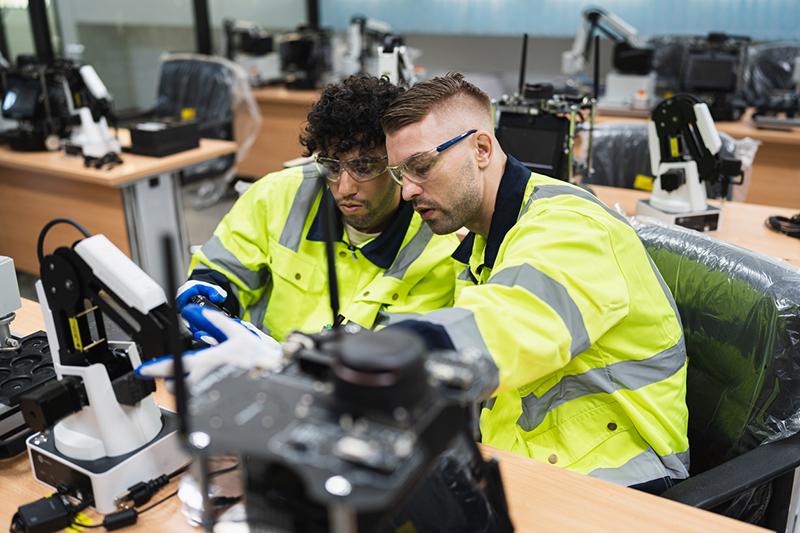
Attending workshops or polishing a résumé in their final semester does not make students career-ready. They need to practise how to work – how to collaborate, navigate ambiguity, manage projects and apply knowledge in context – throughout their academic experience. The reality is that career readiness is not a co-curricular programme; it is an essential part of an integrated curriculum.
To be clear, employers do not expect classrooms to become training centres. What they are asking for – implicitly and explicitly – is graduates who can function in complex environments from day one. That means graduates who can work in teams, communicate professionally with stakeholders, adapt when plans change, apply theory to real constraints and learn continuously on the job.
- ‘Flow’ – not activities – makes experiential learning stick
- Practice makes professional
- Spotlight guide: Get your students workplace-ready
These capabilities do not develop through passive learning. But experiential learning is often misunderstood as a single, high-impact activity: an internship, a capstone project or study abroad. In reality, its power comes from repetition and progression. One experience introduces exposure. A sequence of experiences builds competence.
Reframing the undergraduate experience
We are proposing a paradigm shift: repositioning the undergraduate journey as a four-year professional internship rather than a continuation of the K-12 classroom environment. This doesn’t mean abandoning disciplinary rigour. It means students applying their knowledge in increasingly complex settings – with guidance, feedback and reflection along the way.
In practice, it requires curricular structures that:
- scaffold teamwork across multiple years
- integrate real-world problems early
- normalise collaboration across disciplines
- treat professional skills as something to be practised, not assumed.
When experiential learning is a throughline rather than an exception, career readiness stops being aspirational and starts being operational.
Experiential learning is not the same as ‘hands-on’ learning
It’s important to distinguish between activity and experience. Simply adding projects to a course does not automatically make learning experiential. True experiential learning requires:
- authentic context: problems that resemble the kinds of situations graduates will encounter beyond the university
- responsibility: students must make decisions and be accountable for the consequences of those decisions
- reflection: structured opportunities to think critically about what worked, what didn’t and why.
Without reflection, experience can reinforce bad habits. Without responsibility, it becomes simulation without stakes. Without context, it remains abstract.
Using curricular redesign as a lever
Some academic institutions are beginning to rethink the structure of their undergraduate programmes, not just individual courses, in response to this challenge. At my own institution, a new curriculum, Pamplin+, emphasises cohort-based projects, required co-curricular experiences and integration of experiential learning through industry partnerships in the classroom. We’re repositioning the classroom so students see their four years here as a time to experiment and learn by doing, moving them from day one in the classroom to day one in the boardroom.
What matters here is not the specific model but the underlying principle. Experiential learning works best when it is expected, supported and documented – not optional or invisible. When experiences such as internships, research, leadership roles or teaching assistantships are clearly valued and formally recognised, students take them more seriously. Faculty can connect classroom learning to those experiences more intentionally. Advisers can guide students more strategically.
The role of faculty and institutional culture
Experiential learning also changes expectations for faculty. Designing and supporting experience-rich courses takes time, creativity and institutional backing. Faculty need support not only in pedagogy but in managing partnerships, supervising projects and mentoring students through uncertainty.
Equally important is cultural alignment. If experiential learning is framed as “extra work” rather than core academic labour, it will never scale. Institutions that succeed in this space treat experiential design as central to teaching excellence.
Career readiness as an outcome of belonging and practice
Experiential learning also has an equity dimension that is often overlooked. When career-relevant experiences are embedded in the curriculum, access goes beyond students who already know how to navigate opportunity. Structured experiential pathways help ensure that all students – not just the most confident or well connected – gain meaningful exposure to professional practice.
Students who have practised professional roles repeatedly are more likely to see themselves as professionals. That identity shift is a powerful, and often underestimated, component of career readiness.
Moving from intention to infrastructure
Higher education does not lack commitment to career readiness. What it often lacks is infrastructure – curricular, cultural and organisational systems that make experiential learning inevitable rather than exceptional.
As institutions face increasing pressure to demonstrate value, the temptation is to bolt career outcomes on to existing structures. A more sustainable approach is to redesign those structures so learning and work preparation are part of the same conversation.
Michelle Seref is associate dean of undergraduate programmes and professor of business information technology in the Pamplin College of Business at Virginia Tech.
If you would like advice and insight from academics and university staff delivered direct to your inbox each week, sign up for the Campus newsletter.



comment1