

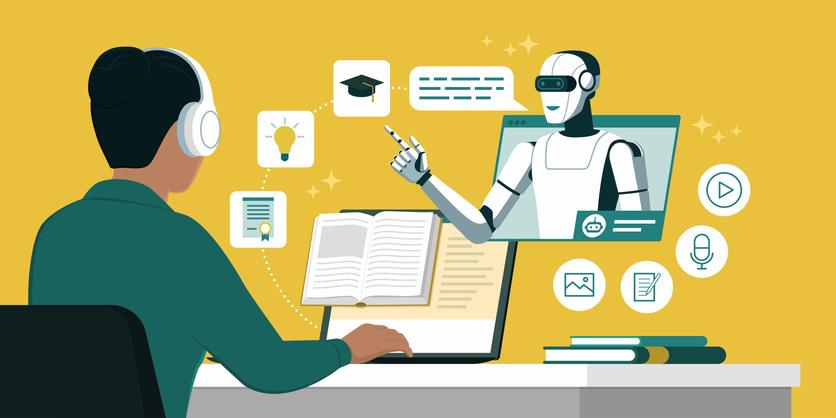
What impact is GenAI having on university assessment? Its capability for personalisation, its efficiency and its scalability offer the potential for sweeping change, yet none of these features automatically ensure learning. They need to be purposely implemented to provide a truly tailored and formative evaluation of what a student has taken in.
With Universidad de La Sabana in Colombia, we integrated an intelligent dashboard for collaborative work into our business school curriculum. It helped educators interact with students and enhanced a formative evaluation experience.
The experience
We developed the tool in an introductory course on economics, organising four learning objectives alongside the curriculum’s outcomes and competencies. The first two, integrating concepts and developing analytical capacity, and intuition, used GenAI as a personal assistant in classroom work rather than evaluations. GenAI would deliver multiple choice quizzes to check understanding or offer short exercises or examples.
The final two objectives, comparing different contexts and working in a collaborative way, had one group assessment where GenAI was deployed in several ways. Students and educators could interact with GenAI as another teammate and as a teaching assistant, offering instant and continuous feedback.
Our aim was to develop assessments that motivated and engaged students with the content, involving them in the learning process. They would use GenAI to enhance their work, develop their own judgement and benefit from the extra guidance and feedback the tool offered.
- What your students are thinking about artificial intelligence
- Spotlight guide: AI and assessment in higher education
- Rather than restrict the use of AI, let’s embrace the challenge it offers
We designed the intelligent dashboard using AI app builder Lovable, with the aid and technical support of the faculty education department. Students completed three assignments and one final presentation over five weeks, submitting their progress on the latter at each stage. They copied the link of their conversation with the tool as part of the evidence, allowing their educator to identify where they were adding value to their work, and ways to use the AI more effectively.
After each weekly submission, the educator generated group feedback in the dashboard with the tool’s support, identifying patterns of use or recurring errors. It also helped identify areas of improvement for the presentations. This feedback was made available to all the students, helping them all benefit.
The final stage, the oral presentation, included feedback from the evaluation team, the educator and the tool, acting as a teaching colleague.
Results
Students were noticeably more motivated and participated more, as the tool engaged them and helped them enhance their work.
On the one hand, it enabled formative, continuous and personalised feedback that allowed students to develop judgement in the use of GenAI, fostering critical analysis, creativity and responsibility in its use, and to work with the chat as if it was another peer. On the other hand, it allowed the educator to generate objective real-time feedback, tailored to each group and with a level of detail unattainable without the tool.
Students also became aware of what they had to put into their work to develop it and add value, concentrating on creation, design and how to enhance their use of the tool rather than knowledge transmission.
In a final reflective exercise, all groups concurred that employing GenAI as an additional collaborator was highly beneficial. They reported having learned to use it more effectively as an information resource – not only to organise, revise and complete the composition and presentation of material, but also “to expedite processes and thereby allocate more time to analysis and comparison”, according to the students.
They also commented that the chat provided a perspective different from the educator’s, offering detailed feedback on form and expression, for example.
In this way, this assessment strategy radically transformed the experience of the course. It can be applied to other subjects and degree programmes that are looking to deploy GenAI as an actor in the teaching-learning process.
Tips for successfully incorporating GenAI into assessments
1. Reflect on the changing role of the teacher
Recognise that the role of educator has shifted from being a provider of content to a curator. You're now a guide of pedagogical approaches that support students’ academic and professional development.
2. Start with small changes
Introduce gradual modifications in class activities to explore how the use of intelligent tools increases student motivation and engagement.
3. Make the importance of these tools explicit
Actively promote the development of skills related to the strategic use of artificial intelligence among students.
4. Encourage dialogue with the tool
Teach that it is not just about “asking” for answers, but about building an iterative exchange. This dialogue also serves as key evidence for teacher guidance.
5. Involve students in how the tool is used
Give students an active role in how they use and adapt AI, fostering a more conscious and critical relationship with the technology. Include instances where how the student used the tool, their decisions, iterations and criteria are evaluated, not just the final product.
6. Integrate GenAI into assessments in diverse ways
Explore different formats that allow for time savings, complement the teacher’s perspective, adpat to different student profiles and enable scalability in assessment design.
Belén Pagone is associate professor and Cecilia Primogerio is education department coordinator, both at the Faculty of Business Sciences at Universidad Austral.
If you would like advice and insight from academics and university staff delivered direct to your inbox each week, sign up for the Campus newsletter.


comment