


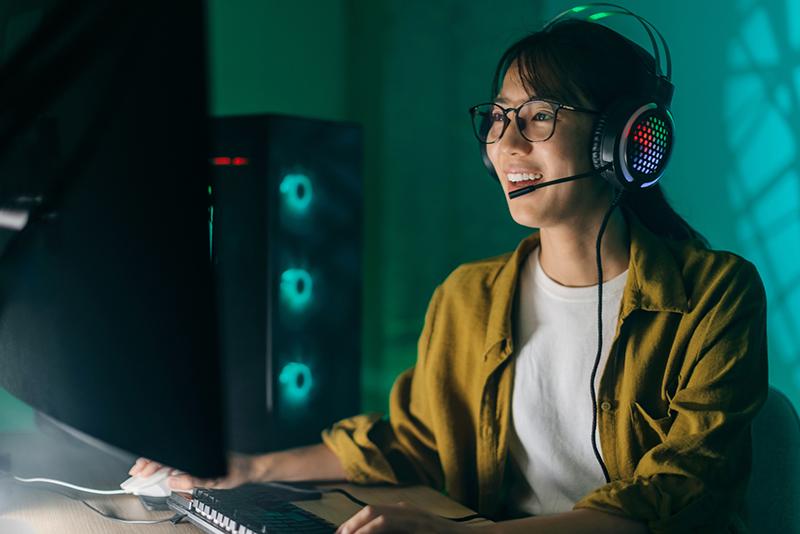
Digital games are central to our cultural and economic lives. In Australia, over 82 per cent of people play games, and they are now a larger part of many students’ media diets than novels, films or television. Over the past three decades, researchers across education, media studies and computer science have also built a compelling case for game-based learning.
This is distinct from gamification, where platforms such as Kahoot add points, timers and leaderboards to familiar tasks like quizzes. We are interested in commercial games played as games – that is, rich cultural texts that students can analyse, critique and learn through, much as they would a novel or film.
Studies have shown that games can support student learning, including critical thinking, systems thinking, problem-solving, multimodal literacies, collaboration and the development of disciplinary knowledge. However, despite this evidence, digital games remain surprisingly uncommon in university teaching.
The reason is not a lack of interest from educators. It is a lack of infrastructure.
As interdisciplinary researchers and educators ourselves, we have repeatedly encountered the same problem. We would identify a game that aligned perfectly with our discipline and our learning outcomes. Students were enthusiastic to engage with it. The empirical research and pedagogical value were clear. Then the practical questions would begin.
How can students play the game?
Who pays for it?
How can a university provide equitable access across hundreds of students?
How does institutional licensing work?
For many educators, these questions end the conversation before teaching even begins.
The access gap in game-based learning
Universities have well-established systems for providing students with books, journal articles, films and specialist software. Libraries negotiate licensing agreements, manage collections and ensure equitable access to educational resources.
Digital games occupy a curious position outside these systems. Although games are more valued as cultural texts and used as learning resources, around the world they are almost never licensed through university libraries. Historically, some institutions have attempted to build teaching collections through physical game purchases, but this approach is increasingly untenable.
Most new game sales now occur digitally, and the proportion of games released exclusively through digital distribution continues to grow. Sony’s decision to end physical PlayStation game releases from 2028 reflects a broader industry shift away from physical media altogether.
- A practical guide to using games in university teaching
- Ready, player one? How video games can help engage students
- Using simulation games to teach lean manufacturing
Libraries cannot simply buy and lend digital games in the same way they do physical books. Institutional use typically requires separate negotiations with individual developers and publishers, legal review, procurement processes and compliance checks for every title. The adoption process becomes onerous and the cost prohibitive.
As a result, educators often improvise solutions. Students are asked to buy games themselves or perhaps academics demonstrate gameplay without providing access, pivot to substandard free games that don’t achieve learning goals as successfully, or abandon game-based learning activities altogether.
Other media industries solved this problem years ago. Films are seamlessly licensed institutionally rather than asking every student to buy individual copies or requiring librarians to seek out the licence holder. No equivalent system has existed for games.
Building the missing infrastructure
We realised that progress in game-based learning depended less on developing new pedagogies and more on addressing the underlying infrastructure problem. This led us to create Ludolio, a platform that enables universities and schools to license commercial digital games through an institutional subscription.
Rather than negotiating title by title, libraries gain access to a catalogue of games selected for their educational relevance, such as the robotics simulator Mars First Logistics, the quantum-science-based puzzle game Schrodinger’s Cat Burglar, and the narrative-driven game Wayward Strand. Students authenticate through institutional single sign-on and access games through a platform designed to meet university privacy, security and procurement requirements. Participating game developers receive a majority share of subscription revenue, creating a sustainable model that benefits both educational institutions and the games industry.
Practical steps for educators and librarians
Even without institutional licensing, educators and librarians can work to make games more accessible. Licensing is a logical starting point. Most game licences cover personal rather than classroom use, so the university’s copyright officer can clarify what is permitted, and independent developers may grant permission for teaching too. Library acquisitions staff may be able to route individual games through existing procurement processes, and some libraries already lend consoles or provide gaming-capable computers on campus.
However, equity extends beyond licensing. A game that requires a high-end PC will exclude some students, as does a 40-hour campaign for those juggling paid work or caring responsibilities. Titles that run on ordinary laptops, and that can be finished in a few hours, widen participation considerably.
Accessibility features matter just as much. Subtitles, remappable controls, colour-blind modes and adjustable difficulty can determine whether a student is able to play at all, and resources such as the Game Accessibility Guidelines webpage and Can I Play That? offer useful guidance. Recorded playthroughs, paired play and in-class demonstrations mean students can still engage critically when playing is not possible for them.
As Cassandra Barkman at the University of Melbourne, who recently wrote the report Making Games Available in Higher Education, explains, “teaching games in the classroom is challenging given we can never assume every student has played or has access to the same games”.
From educational innovation to educational infrastructure
Universities often focus on innovation in teaching practice. Now is the time to invest in emerging technologies that can improve student learning, engagement and outcomes.
These are important aims. But innovation only succeeds when students can access the necessary resources.
Libraries transformed learning not because they proved books were educationally valuable, but because they created systems that made books accessible. The same is true of journals, films and software. Digital games may be approaching a similar moment.
If games have earned their place in the curriculum, perhaps the next question is obvious: when will they earn their place in the library?
Marcus Carter is a professor in human-computer interaction and founder of Sydney Games and Play Lab; Jen Scott Curwood is an associate professor in education in the Sydney School of Education and Social Work and director of the Sydney Games and Play Lab; Ben Egliston is an Australian Research Council DECRA fellow and senior lecturer in digital cultures in media and communications; and Eduardo Velloso is a professor and deputy head of the School of Computer Science in the Faculty of Engineering. All are at the University of Sydney.
If you would like advice and insight from academics and university staff delivered direct to your inbox each week, sign up for the Campus newsletter.


comment