


Assessment is usually done to students. Educators mark assignments, award grades and deliver feedback. Students, the passive recipients in this process, often glance at the grade but ignore the feedback that could help them grow.
But what if assessment were a skill that students also learned? What if they were trained not just to produce work but to judge whether that work, and the work of others, truly met the criteria?
This shift would offer more than good pedagogy. It would prepare students for the workplace, where evaluating outputs, providing constructive feedback and revising your own work are daily requirements. And as artificial intelligence becomes embedded in classrooms and offices, evaluative judgement, the ability to critically assess both human and machine-generated work, has never been more important.
- The evolution of authentic assessment in higher education
- Ask students to create assessments for industry insight
- Spotlight guide: reframe assessment as part of learning
While providing feedback and modifying work require reflection, adaptability and resilience, the openness to ask for feedback is equally important. What do others think of my work? What did they notice that I overlooked? These questions foster humility and curiosity, transforming assessment from a one-way judgement into a collaborative process.
Shift the assessment mindset
How do we move students from fearing feedback to seeking it, and from seeing grades as an endpoint to using evaluation as a tool for learning?
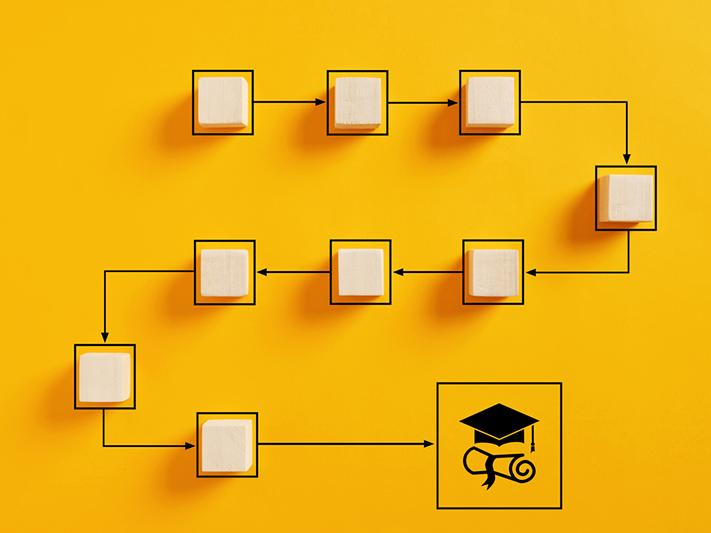
The key lies in embedding structured cycles of peer and self-assessment into the curriculum as a regular practice. Students begin with a short activity, then evaluate a peer’s work anonymously using a clear rubric. They pair with another student who assessed the same work to discuss their evaluations and reach a consensus. After this peer-assessment experience, students receive their own work back to self-assess and revise using the same criteria.
This sequencing matters. When students evaluate someone else’s work, they develop what researchers call “distanced objectivity”, the ability to apply criteria critically without the emotional investment that clouds self-evaluation. The discussion phase is particularly transformative, as students articulate their judgements, compare interpretations of quality and learn to give constructive (rather than merely critical) feedback.
This is not a one-time exercise. To build mastery, students need repeated practice to calibrate their judgement against standards. When students engage in structured cycles of peer and self-assessment, their accuracy in judging the quality of their own work improves significantly over time. Repeated practice with clear criteria builds confidence and alignment with academic standards.
Students also report that giving feedback is as valuable as receiving it, strengthening their understanding of what counts as quality work. Indeed, many students gain more from evaluating their peers’ work than from reading comments on their own submissions. Taking on the role of assessor provides an opportunity to step back, apply standards critically and transfer those insights to their own work. In this way, feedback becomes less about grades and more about cultivating judgement, reflection and the willingness to revise.
Why this matters for higher education
When students engage in structured peer assessment, they must apply clear criteria to a variety of submissions. Evaluating a weak argument or identifying missing evidence encourages students to articulate precisely why a piece of work fails to meet a standard, and it reinforces what a strong submission requires. Seeing multiple approaches, both successful and less so, reveals that there is rarely one “perfect” answer, but that clear benchmarks hold for rigour, clarity and creativity. This comparative process moves students from passively receiving a definition of quality to actively constructing their own understanding of it, through dialogue, critique and reflection.
A common concern is that if peer work is of low quality, students may internalise flawed standards. However, this concern overlooks a crucial pedagogical principle: the ability to accurately define quality is built through comparison and contrast. Students do not need to assess excellent work every time to learn what excellence is. Even imperfect work becomes pedagogically useful because it reveals the gap between the response and the standard. The act of detecting weaknesses, justifying their decisions and proposing improvements is what develops students’ evaluative judgement. Quality, in other words, is learned through contrast, not only through exposure to exemplary work.
Embedding peer and self-assessment also makes assessment more transparent and has the potential to shift the culture of learning. It is not merely about adding another task. It is fundamentally about rethinking assessment as a form of learning itself. Instead of fuelling the stress of competition that often dominates academic environments, these practices encourage students to recognise that there are multiple valid versions of what constitutes quality work. Students build resilience when receiving feedback, confidence when giving it and the capacity to take responsibility for the quality of their contributions.
The benefits of this approach extend well beyond the classroom. Such skills also prepare students for a world in which they will need to regularly evaluate their own work and that of others. When students learn to give and receive feedback constructively, they develop skills in collaboration, empathy and communication, which are often crowded out by the race for grades in education but are essential for the workplace.
In an era of generative AI, these skills are even more urgent. Learning to critically evaluate the work of their peers is a foundation for judging whether AI-generated content meets professional or academic standards. The ability to question, critique and revise is the best safeguard against outsourcing judgement to the machine.
A call to action
Assessment practices often treat students as passive subjects rather than active evaluators. By embedding peer and self-assessment into curricula as regular practice, we can shift this culture.
It can be seen as a learning opportunity rather than a final judgement. The time has come to rethink assessment as learning itself. When students learn to assess their own work, their peers’ work and, yes, even the outputs of AI, they build a lifelong skill that transcends university and serves them throughout their careers.
Elissar Gerges is an assistant professor in the College of Interdisciplinary Studies at Zayed University, UAE.
If you would like advice and insight from academics and university staff delivered direct to your inbox each week, sign up for the Campus newsletter.
comment1
(No subject)