

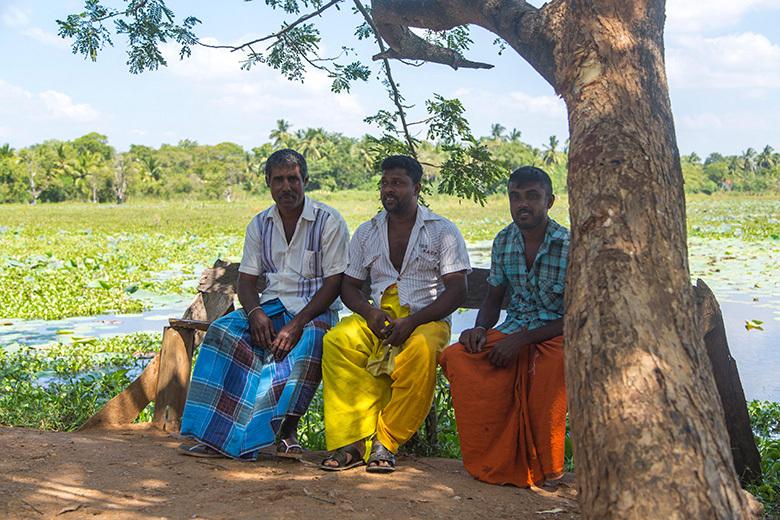
I did not learn the value of collaboration in a university seminar room. I learned it on shrimp farms in Sri Lanka.
Disease outbreaks were devastating shrimp farms across the region. Every operation tried to solve the problem independently. Farmers guarded information, hid failures and competed against one another. Nothing improved.
Then finally, everything changed – but only when communities began working together. Farmers formed societies, shared observations and coordinated responses. Collaboration became the difference between collapse and resilience. Long before I became a researcher, I learned an important lesson from this: complex problems cannot be solved in isolation. That lesson has shaped every stage of my academic career since.
Shared ownership
Today, as a researcher working with Indigenous and local communities in places ranging from the Canadian Arctic to Sri Lanka, I continue to return to the same principle: collaboration succeeds only when people have genuine ownership over the work itself.
Too often in academia, we still approach communities as “subjects”. That implies that people exist primarily to provide data for someone else’s research agenda. Communities have experienced this kind of extractive research for generations. Researchers arrive with pre-designed questions, collect information and publish papers – then leave. Meanwhile, the community’s own priorities remain unaddressed.
- Uncovering Indigenous insights: let’s research together
- Decolonisation to Indigenisation: how can institutions centre Indigenous knowledge?
- Equitable research partnerships are no longer optional – here’s how to make them a reality
One Inuit elder I worked with expressed this frustration clearly during the Covid-19 pandemic. He told me: “Researchers come to us to find answers to their [research] problems, but no one visits us to find answers to our problems.”
He was right.
Too often, academic collaboration still operates as extraction. Universities celebrate collaboration rhetorically while continuing to reward speed, ownership and academic authority. But meaningful collaboration requires something more difficult: researchers prepared to share control over the work itself and a willingness to invest time.
50/50 research
That shift permanently changed how I approach research partnerships. Today, I am deeply committed to co-planned and co-designed research. I still arrive with expertise, ideas and research frameworks, but communities bring equally important knowledge, lived experience and priorities. I often describe this as “50/50 research”. Researchers bring 50 per cent; communities bring the other 50 per cent. The percentages are symbolic rather than literal; the point is that both forms of knowledge are important.
Successful collaboration does not mean abandoning academic rigour or expertise. It means approaching partnerships with humility and flexibility. Researchers need to spend time understanding community values, histories and cultural contexts before deciding what questions matter most. We need honest dialogue about expectations, goals and benefits from the very beginning.
That process cannot be rushed. Meaningful collaboration is often slower, messier and less predictable than conventional research models.
When I received one of my first US National Science Foundation grants after joining Virginia Tech, much of the funding supported relationship-building and co-planning with Arctic communities before the research formally began. Those conversations shaped not only the research questions but also the methods themselves. In my experience, this produces more impactful scholarship.
Enduring relationships
Importantly, collaboration should not end when a grant cycle finishes or publication is secured. The strongest partnerships evolve because communities themselves evolve. During my PhD research, I studied Indigenous fisheries systems and food security. During the pandemic, our collaborative networks quickly shifted focus to understanding how these communities were responding and managing new forms of vulnerability. Over time, the work expanded again to examine the interconnected impacts of climate change, food systems and health.
The research transformed because the relationships endured.
Today, I continue this work through the Indigenous Peoples Observatory Network (IPON), an international collaboration involving Indigenous and non-Indigenous researchers across 17 countries and more than 100 Indigenous communities worldwide. Through this network, we support collaborative research, mentoring and knowledge exchange across disciplines, countries and generations. The network creates opportunities for collaboration across Global North and South contexts that are too often disconnected in academic research.
My Indigenous Resilience Innovation Lab (IRI Lab) similarly focuses on participatory and community-driven approaches to resilience and research.
For universities eager to strengthen interdisciplinary and international collaboration, there is an important lesson here: the hardest barriers are often not technical or disciplinary. They are relational. Collaboration depends on trust, and trust depends on people feeling respected, heard and included in shaping the work itself.
Students as co-collaborators
The same principle applies inside universities themselves.
As a student, I experienced academic environments shaped by enormous power gaps between professors and students. Those hierarchies often made students hesitant to speak openly, take intellectual risks or ask questions freely. I struggled within that system, and that shaped the kind of mentor I wanted to become.
Today, I try to minimise such hierarchies in my own lab and research teams. Students perform best when they feel comfortable contributing ideas freely rather than worrying about authority or status. Collaboration is never one-size-fits-all, so I mentor students differently according to their backgrounds, goals and experiences. But all students need the same core things: trust, responsibility, mentorship, training and the freedom to find their own rhythm as researchers. Many of my students come from different cultural and linguistic backgrounds, and those differences often strengthen the collaborative process rather than limit it.
When students participate directly in community-based research, something powerful happens – they stop seeing themselves as merely assistants completing assigned tasks. They begin taking ownership of the work. They develop confidence, responsibility and deeper cultural understanding.
I have seen undergraduate and postgraduate students grow into independent researchers after participating in Arctic fieldwork and international collaborative projects. Often, the most important transformation is not technical. It is relational. Students begin to understand that meaningful research is not something we do to communities. It is something we build with them.
The best collaborations do not simply produce better research. They change the people involved in the process. In an era defined by complex global challenges, the future of research may depend less on individual expertise and more on our ability to build meaningful relationships across disciplines, cultures and communities.
Eranga K. Galappaththi is assistant professor in the department of geography at Virginia Tech. He is also founding director of the Indigenous Resilience and Innovation Lab.
If you would like advice and insight from academics and university staff delivered direct to your inbox each week, sign up for the Campus newsletter.

comment